








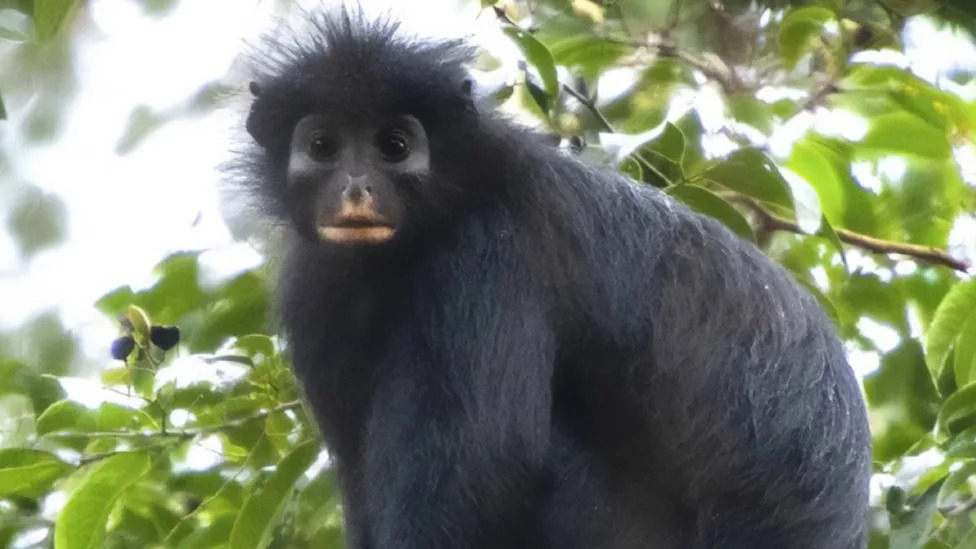
When biologists discover a new species in the 21st century, it's usually through new DNA analyses, more detailed microscopic examination, or collecting samples far outside the human comfort zone.
And yet, primatologists have just confirmed the existence of a species of monkey that has remained under the radar of science until now.
Meet Colobus congoensis , a monkey that has long hid in the tropical forests between the Lomami and Congo (Lualaba) rivers in the east-central Democratic Republic of the Congo (DRC).
Even people living within the monkey's range have rarely seen it.
When this happened, the people of Bangala called him "Liqweli"; the locals of Mituku called him "kasaba nkoni", meaning "shaker of the branch".
Lukuru Wildlife Research Foundation conservationists Bernard Ikembelo and Ashley Vosper obtained the first photographic evidence of the Likweli species in 2008 in what became Lomami National Park in 2016.
But even this was only a fleeting glance.
Now, nearly 20 years later, researchers have collected 114 field observations of Likweli and have enough evidence to confirm that it is indeed an entirely new species of primate.
This species was officially announced in a scientific journal. PLOS One .
«"Following the first [photographed] sighting, no further reports were received until November 2018, when Jean-Pierre Capalé led a patrol in the Courbures sector and photographed a black monkey with light markings around the mouth and a white perianal patch," writes the research team, which includes researchers from institutions in the DRC and the United States.
This monkey was unlike any other seen in the area.
«"Over the next 10 months, Kapale and his team, using patrols and targeted searches accompanied by local field assistants, found and photographed the monkey seven more times in different locations," the team reports.
By adding additional photographs taken during patrols by other teams working in Lomami National Park, the researchers have compiled a dataset large enough to confirm the existence of the new species: 114 observations across an area of approximately 1,700 square kilometers between 2018 and 2022.
«"This discovery is both exciting and deeply personal, highlighting the extraordinary biodiversity of my homeland and how much remains unexplored," says biologist Junior Amboko of Florida Atlantic University.
«It is a great honor for me to name this species.„ Colobus congoensis “paying tribute to the remarkable natural heritage of the Congo Basin and, we believe, noting that this is the first primate named after the Democratic Republic of the Congo itself, highlighting both its global significance and local pride.».
It must be said: these monkeys have gorgeous faces, with inquisitive dark eyes, cheekbones that Cher herself would envy, and model-like pinkish-orange lips that could inspire a whole new lip makeup trend.
The monkey's smooth black fur and long, drooping tail contrast with the shock of spiky hair that spreads out around its distinctive face.
Genetic analysis has shown that this species is separated from its closest relative by 4 or 5 million years.
«"Opening Colobus congoensis "This changes our understanding of the evolution of African apes," says anthropologist Kate Detwiler, also of Florida Atlantic University.
«"His closest known relative is Colobus satanas , which lives more than 1,200 kilometers away in west-central Africa. However, our genetic data indicate that these two species diverged approximately 4-5 million years ago, marking one of the oldest known evolutionary splits in the colobus lineage.".
It's not just its physical and genetic characteristics that distinguish it from other members of its kind: six audio recordings have shown that its deep roar also has a unique acoustic signature.
On topic: In the Namibian Elephant Corridor, the war for territory between humans and wildlife is about to escalate.
And it may have been discovered at the very last moment: its range is limited, and like other species in the region, it faces habitat loss and hunting pressure.
«"Opening Colobus congoensis »It’s both a scientific triumph and a sobering reminder that some of the rarest creatures on Earth could disappear before the world even knows they exist,” says Detwiler.
The results of the study were published in in the journal PLOS One .
This article was fact-checked by Rachel Garner and edited by Michael Irving. While we pride ourselves on our process, we're only human. If you spot an error, please let us know.
ScienceAlert articles are written, fact-checked, and edited by humans; they are never generated by artificial intelligence. Don't miss a single article; subscribe here.
Related news
-
The world's oldest amber was found on a planet that existed 150 million years before the dinosaurs.
-
«A 'terribly rare' discovery: Tyrannosaurus rex babies were smaller than cats and were born in dozens.
-
Most people don't even realize that bees produce silk, but scientists have just figured out how to use it.