








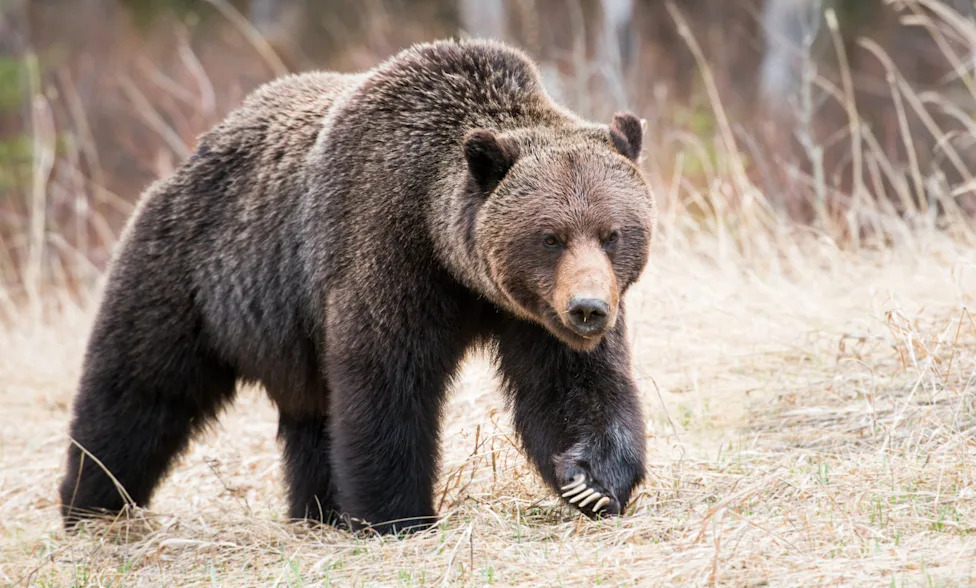
Yesterday, the Department of the Interior announced preparations to transfer most of the management of the grizzly bear population to the game and fish departments of western states. This move could ultimately lead to the bears being removed from the federal protected species list and the resumption of hunting for this iconic species.
The announcement by Interior Secretary Doug Burgum and U.S. Fish and Wildlife Service Director Brian Neswick was made in prime brown bear habitat north of Yellowstone National Park in the presence of western state governors. While details of specific management changes are scarce—federal regulations will be released on Friday—the Interior Department emphasizes that it is not removing federal protections for brown bears under the Endangered Species Act. Rather, it proposes "to clarify the geographic area in which brown bears in the continental United States are protected under the Endangered Species Act.".
In areas where the Department of the Interior determines bears do not deserve protection, either because their numbers have exceeded thresholds or because they pose a threat to life or property, the U.S. Wildlife Service also "proposed changes to existing protection regulations to provide additional management flexibility for authorized agencies and individuals facing conflicts with grizzly bears.".
Public comment on the proposed rule, a revision of the so-called federal 4(d) rule, will be accepted until August 17.
The news was widely welcomed by hunting and livestock groups, as well as the Republican governors of Montana, Idaho, and Wyoming, who said their respective agencies were ready to assume responsibility for managing bear populations, which have grown from a few hundred when they were listed as endangered in 1973 to more than 2,000 today. Grizzlies are steadily migrating from their core habitats in the Bob Marshall Wildlife Refuge south of Glacier National Park and the Yellowstone ecosystem to habitats and communities unaccustomed to these apex predators and scavengers.
Yesterday, a rule was announced allowing state and tribal wildlife agencies to activate their own grizzly bear management plans in coordination with the U.S. Wildlife Service (USFWS). Don't expect states to immediately begin proposing grizzly hunting seasons, as many conservation groups have warned. At least in Montana, the Department of Fish, Wildlife, and Parks has imposed a five-year moratorium on grizzly bear hunting.
«"Director Neswick, Secretary Burgum, and the entire Interior Department leadership have found a way to declare a victory for conservation under the Endangered Species Act and ensure the continuation of state-managed conservation," said Simon Roosevelt, executive vice president of conservation, research, and policy at the Boone and Crockett Club. "This rule moves grizzly bear conservation from the already-solved problem of bear scarcity to the emerging reality of bear abundance. The predictable and misleading criticism of this is that bears are losing protection. The correct view is that bears and people benefit from sustainable management.".
Burgum's statement did not specify whether or how much federal support would be provided to states for additional grizzly bear management efforts. According to the Interagency Grizzly Bear Research Group, at least 72 grizzly bear deaths, mostly at the hands of humans, were recorded annually in both 2024 and 2025. This is approximately 35 percent higher than the 10-year average of 54 bear deaths. According to the Montana Grizzly Bear Conflict Dashboard, 101 conflicts have been recorded in the state this year, including 30 livestock attacks and 34 human-related conflicts.
Back from the brink
In 1975, grizzly bears in the continental United States were listed as endangered under the Endangered Species Act. While federal controls allowed the population to expand, they also made them pariahs among western ranchers and some hunters, who resented the protections imposed by what Bergum called "Washington bureaucrats"—federal wildlife managers.
Supporters of this week's Interior Department announcement are quick to point to the population increase, insisting that the grizzly population has fully recovered and should be managed by state conservation agencies. However, environmental groups argue that the census data is misleading. They argue that the percentage of suitable habitat occupied by these bears is a better indicator of population recovery.
«"It is deeply troubling that the Trump administration is seeking to hand over management of the grizzly bear population to hostile Northern Rocky Mountain states," said Jenny Harbine, chief legal officer for Earthjustice's Northern Rocky Mountain office. "While we need to review the details of this proposal, it could further endanger grizzlies during a time of record-breaking mortality. Political maneuvers against science that could hinder grizzly bear recovery are unacceptable. If this proposal further harms the species, we are prepared to sue the administration.".
However, Montana Governor Greg Gianforte noted that the dramatic increase in brown bear populations should be seen as proof of the effectiveness of the Endangered Species Act, and that the return of population management to states should be hailed as a conservation success.
«"This success has brought with it a challenge—bears have expanded into new areas, and conflicts with farmers, ranchers, recreationists, and local residents have increased," Gianforte said at a Department of the Interior press conference south of Bozeman, Montana. "Returning population management to the states is a welcome change, and Montana is ready to lead the way in balancing conservation with the safety of our communities.".
Boone and Crockett Club spokesman Roosevelt says the fact that population management may shift from federal to state authorities does not mean the grizzly bear population's recovery is complete.
Amendments to the Endangered Species Act in the 1990s failed to provide a consistent path for species to recover so they could remain outside federal protection.
«"As a result, every attempt to delist the bear is challenged by tactically savvy lawyers who exploit this policy gap to overturn decisions based on sound science," says Roosevelt. "These politicized maneuvers, aimed at keeping grizzlies protected in areas where they currently thrive, have the opposite effect, diverting needed resources from the more than 1,000 other species that rightfully remain listed as endangered.".
A change in the U.S. Wildlife Service's grizzly bear regulations allows federal protections to be maintained for the animals in some ecosystems, while shifting management to state agencies in others.
The question of "harm"«
Almost simultaneously with Bergum's announcement regarding grizzly bear management, the Department of the Interior, together with the federal Department of Commerce, announced last week the removal of the word "harm" from the list of prohibited actions under the Endangered Species Act (ESA). This single word underlies the federal law's authority to ensure habitat conservation not only for endangered species but also for wildlife not federally protected.
By repealing the normative definition of «harm,» federal law can be returned «to its original state.».
«"The original text and the original intent that will end years of federal abuse of power.".
Citing a 2024 Supreme Court decision, "the agencies determined that the previous definition of 'harm' constituted an unlawful interference with the law that violated private property rights.".
However, legal experts emphasize that this term underlies much of the Endangered Species Act (ESA)'s authority, allowing agencies to protect critical habitat or impose penalties for damage. Combined with the Trump administration's repeal of the federal Roadless Rule and mandated increased logging in brown bear habitat, the removal of the "harm" clause could slow or reverse conservation gains made under federal protection, bear advocates argue.
«"I view this as a dress rehearsal for delisting the species," Christy Clark, director of the Montana Department of Fish, Wildlife and Parks, said after Bergum's announcement, according to the Montana Free Press.