






It's possible to tell which Real Housewives contestants are pro-gay and which aren't. For those involved, Ashley Darby is definitely not a MAGA supporter, and it shows in her appearance. Right now, America feels like a MAGA housewife. No one wants to do her makeup. No one wants to design her dresses. No one wants to take her picture. No one wants to take her out for her birthday.
It's a shame, because America is turning 250 years old. .
Although America gave the world jazz, disco, hip-hop, punk, house music, drag, Linda Ronstadt, Dolly Parton, Prince, ballroom culture, Public Enemy, Hole, Buffalo chicken wings, Springsteen, Beyoncé, Madonna, lobster sandwiches, «The Hunting Wives» , airplane, Bad Bunny, «The Real Housewives of Salt Lake City» and the deeply sacred tradition of getting blackout drunk at a fair and throwing up next to the Gravitron ride, she definitely won't be getting a huge birthday party this year.
Instead, America's 250th anniversary celebration promises to be the most musty, sad, "country fair on fentanyl" nostalgia concert imaginable.
For America's 250th anniversary, Donald Trump and his entourage orchestrated a celebration so aggressively tasteless, confusing, and spiritually empty that even some of the announced attendees immediately began publicly distancing themselves from it, like passengers escaping a sinking Carnival cruise ship suffering from both hantavirus and norovirus.
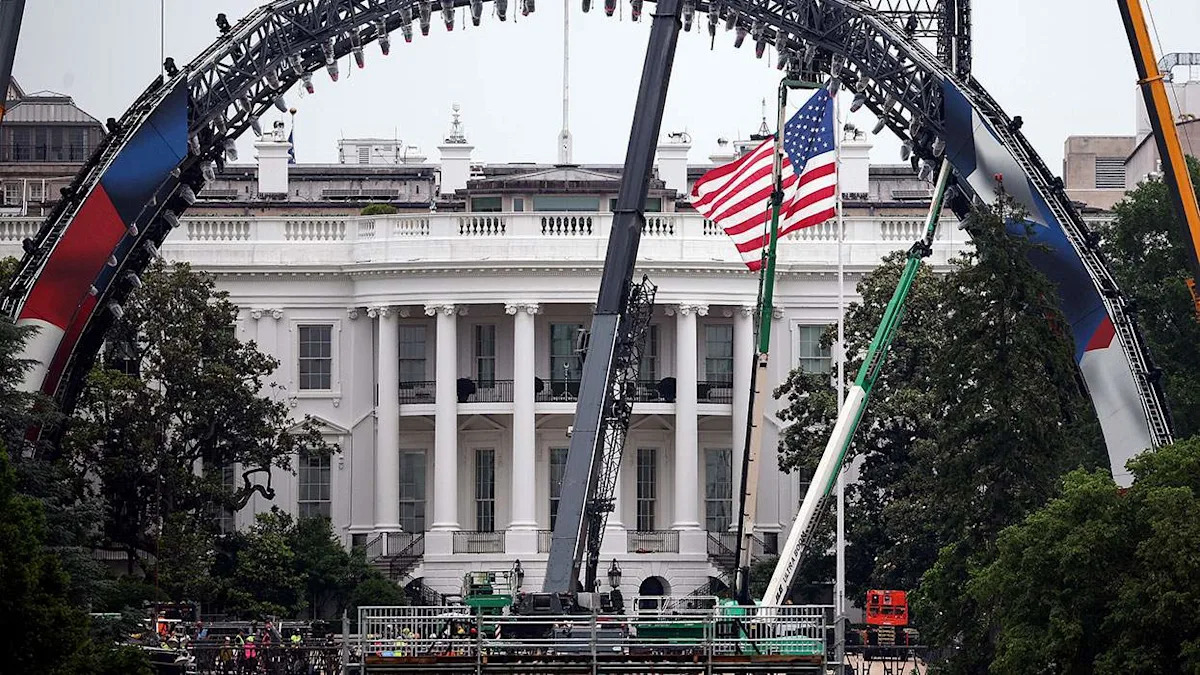
Nothing says "the enduring value of American democracy" like Vanilla Ice, a UFC cage on the White House lawn, and film screenings. «National Treasure 2» . Or perhaps, at this stage of our national decline, that is precisely what it says.
The event, dubbed "The Great American State Fair," somehow manages to feel simultaneously dystopian and impotent. It feels less like a national landmark and more like a regional casino entertainment coordinator given access to federal infrastructure, a Pinterest account, and a moderate cocaine habit.
And people either laugh at the lineup or ignore it entirely. It's not because all the artists involved are talentless. Some are well-respected, legendary performers. One such group is C+C Music Factory, which infamously replaced legendary vocalist Martha Wash in music videos because management deemed her too fat for television. And yet, the entire production radiates the energy of someone standing in the electronics section of Walmart, shouting that no one makes real music anymore, while Kid Rock blasts from a Bluetooth speaker at maximum volume.
America deserves better for its 250th anniversary than this cheap hodgepodge of complaints orchestrated by people who seem fundamentally to dislike contemporary American culture.
What makes this whole spectacle especially awkward is that it takes place during a period of incredible boring Mass cultural production. Corporate consolidation has transformed vast swaths of American life into a single, algorithmic hiss. The entertainment industry increasingly resembles a machine designed for the endless recycling of intellectual property, focus-group-driven nostalgia, and sequels to sequels that no one wants. Much of contemporary culture can seem as interchangeable as the wallpaper patterns that once adorned suburban dining rooms in the 1990s: familiar, unobtrusive, pastel, and ultimately forgettable.
Unfortunately, we live in a political culture where many of those responsible for popularizing American culture possess the intellectual depth of a drained paddling pool. Their understanding of art rarely extends beyond what's right in front of them. They confuse visibility with significance, and popularity with importance. They believe that whatever occupies the biggest screen—or, more often, the small, glowing screen right in front of their faces, receives the biggest marketing budget, provokes the loudest outrage cycle, or dominates social media feeds—must somehow reflect the state of American culture itself.
What's particularly absurd is that the algorithmic culture many of these people consume is specifically designed to narrow their field of vision. It rewards familiarity over discovery, outrage over curiosity, repetition over exploration, mediocrity over discomfort, and certainty over complexity. The result is a worldview in which culture seems simultaneously omnipresent and incredibly narrow. They are surrounded by information, yet encounter it extremely rarely. They consume endless amounts of content, yet remain strangely disconnected from the real artistic, intellectual, and creative life unfolding around them. And they will never understand that the most interesting American art almost never existed in the mainstream.
Beneath the surface of an increasingly commercialized culture, something far more interesting is constantly happening. Artists are creating their work in bedrooms, basements, warehouses, community centers, independent venues, Discord servers, and corners of the internet that most politicians couldn't detect if their lives depended on it. Immigrants, drag queens, punks, rappers, filmmakers, DJs, writers, designers, performers, and countless other oddballs are creating entirely new cultural languages in real time. Their work is chaotic, global, sexual, contradictory, offensive, vulnerable, brilliant, and unruly. This is precisely what makes it threatening.
It can't be created through focus groups. It can't be collectively fabricated. It can't be reduced to a slogan, neatly folded into a campaign platform, licensed for a streaming service, or turned into a nostalgic fantasy of an America that was supposedly better before all those "bad" people came along and started making life interesting. Real culture is unruly. It emerges from clashes and tensions. It emerges from communities reimagining identities, histories, aesthetics, traditions, and experiences in ways that established institutions rarely understand until years later.
What makes this moment especially compelling is that much of this creativity is emerging in direct response to the stifling anonymity of popular culture itself. People are increasingly tired of stale entertainment, collectively optimized for profit. They're tired of brands cherry-picking just enough to shove it into a Walmart ad and claim they're creating some profound work of art. We're collectively tired of corporations treating culture like raw material to be extracted, repackaged, monetized, and sold back to us with an advertising campaign tacked on that reflects their lifestyle. We're tired of content masquerading as culture. We're tired of nostalgia masquerading as creativity. We're tired of people with huge budgets and no imagination insisting they're visionaries simply because they own the distribution channels.
As a result, artists are beginning to return to something older, riskier, and far more dangerous: making things because they have something to say.
This impulse has always been at the core of American cultural innovation, because the country's most influential artistic movements rarely emerged from institutions attempting to preserve culture. They arose from people who refused to accept the version of America they inherited. Outsiders, immigrants, dissidents, LGBTQ+ people, artists, musicians, writers, and communities who, looking at the dominant culture of their time, found it incongruous with the reality of their lives. They arose from people who were alienated, ignored, undervalued, poor, sexually driven, angry, ecstatic, fearful, ambitious, or simply out of place—and from clashes of identities, traditions, histories, and experiences that, according to conventional wisdom, should never have combined.
If you wanted to create a truly inspiring celebration of 250 years of American culture, this is where you would look. You would look to the people creating the future, not to the endless recreation of an imaginary version of the past, and to the communities and creators who continue to expand the definition of what America can be, not to romanticize periods marked by racism, misogyny, homophobia, xenophobia, repression, and an almost supernatural commitment to bad taste.
Instead, we're dealing with a cultural festival orchestrated by people who increasingly position themselves as defenders of American culture, while they themselves seem fundamentally incapable of engaging with contemporary American culture as anything other than critics, spectators, or opponents. Every film becomes propaganda, every pop star a threat, every TV show a testament to the decline of civilization, and every cultural event ultimately devolves into a hostage situation where someone screams about pronouns.
That's why the country that gave the world jazz, disco, punk, hip-hop, house music, drag, ballroom culture, and countless other world-changing arts ends up celebrating its 250th anniversary with a bizarre hybrid of WWE, History Channel, and a fairground, assembled by people who seem genuinely outraged that the country has changed since 1987, or 1957, or maybe 1857.
What's even funnier is that many of the artists themselves are increasingly refusing to have anything to do with it. Morris Day and The Time responded to rumors of their participation with the digital equivalent of "no way," while Young MC publicly clarified that he doesn't want to participate in a politically charged spectacle, which makes perfect sense—no one wants to wake up one morning and discover they've accidentally become part of the halftime entertainment at a women's rights game.
This whole situation is especially sad because America truly deserves a grand, ridiculous, and beautiful birthday celebration. We are a noisy, absurd, and contradictory country. Our chaos is not a flaw. It's the American story. The strength of American culture has always been not purity, nostalgia, or tradition, but a nearly unmatched ability to absorb new influences, new communities, new ideas, and new voices before transforming them into something unprecedented. Our greatest artistic achievements have emerged from friction, experimentation, vulnerability, courage, sexuality, imagination, and, at times, beautiful catastrophe, so it's strange to see the country's 250th anniversary celebration being handed down to people who seem actively suspicious of almost every force that made American culture worthy of celebration.
America deserves a holiday worthy of this legacy. Instead, it gets something like a sickening, spoiled child who got sick at a fair.
Josh Ackley — political strategist and frontman of the queer punk band The Dead Betties. @momdarkness
Opinions Section« is dedicated to publishing a wide range of inspiring personal stories and influential voices from the LGBTQ+ community and its allies. Visit Out.com/submit to learn more about our submission guidelines. We welcome your feedback and comments on any of our articles. Email us at voices@equalpride.com. The opinions expressed in Opinion articles are those of guest writers, columnists, and editors and do not directly reflect the views of Out or our parent company, equalpride.
This article originally appeared on Out: America Deserves a Better 250th Anniversary Celebration.
CONNECTED
-
The Kennedy Center Honors ceremony will be renamed in honor of Donald Trump.
-
Trump is using his State of the Union address to demonize transgender children and their families.
-
Donald Trump accepted an invitation to a correspondents' dinner, calling himself "one of the greatest presidents.".