








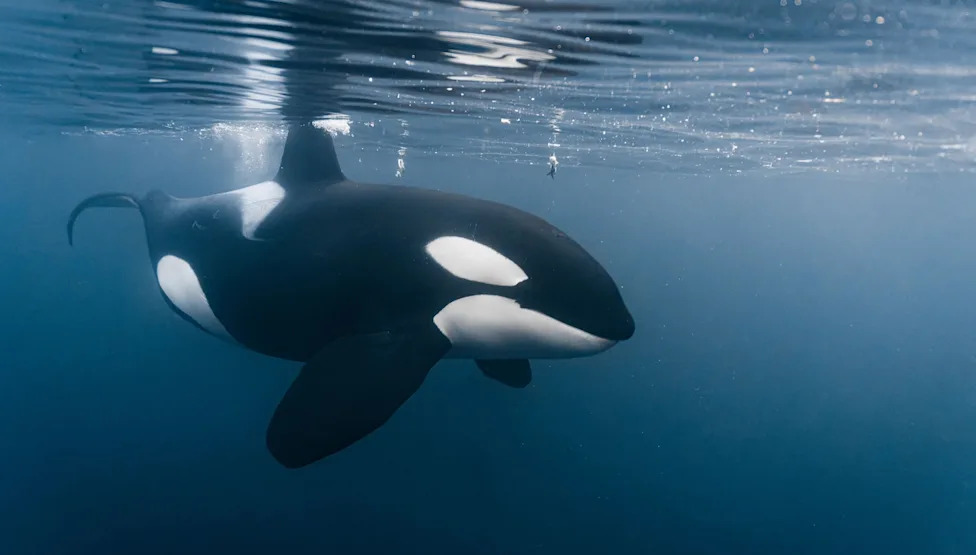
A drone flight off the coast of Mexico's Baja California Peninsula captured the striking moment a female orca appeared to be teaching her calf how to hunt sea turtles.
What's happened?
Alonso Rodriguez, a drone operator and founder of Mares De Mexico, captured the scene during a trip to the Gulf of California with local fishermen and while working with researchers studying orcas in the area.
As National Geographic reported, nine killer whales appeared near the boat towards sunset. After the mother and calf separated from the pod, Rodriguez launched his drone.
Aerial footage shows a killer whale catching a sea turtle and then handling it in a manner unusual for researchers. National Geographic shared footage of the encounter.
Instead of killing the turtle immediately, she held it underwater for several minutes, rolling and twisting it, and tugging on its flipper while the baby remained nearby.
Rodriguez He told National Geographic: "I always try to carry a camera with me and be prepared because you never know when something might happen in the ocean.".
He added: "The moment I saw [the turtle] come into the frame, I thought, 'Wow, something special is about to happen.'".
Because the mother delayed feeding, scientists are investigating whether the killer whale was playing with her prey or whether the calf was being given the opportunity to learn hunting behavior.
Why is this important?
Philippa Breaks, an animal behavior researcher at the University of Canterbury in New Zealand, told Nat Geo that demonstrating learning methods in animals is particularly challenging.
She explained that proving that an animal "teaches is a much more difficult task because it requires you to think about another person's intentions and theory of mind without being able to interview them.".
To prove the existence of a learning process, researchers typically look for three indicators. First, does the older animal change its behavior toward the younger one? Second, does this change help the younger animal learn faster? And third, does this entail an investment of time or energy for the older animal?.
In this case, this may be due to the extra time the mother spent with the turtle, rather than feeding it immediately. Breaks added that the video is consistent with the idea of training, as the mother appears to be demonstrating how to immobilize prey during an escape.
Subscribe to TCD's free newsletters to receive helpful tips, actionable advice, and a chance to win $5,000 toward your home improvement. To see more stories like this, change your Google preferences here.