








We may be one step closer to answering the most intriguing cosmic question: are we alone?
Our trusty robotic explorers have been scouring Mars for signs of life since the 1970s, and one theory is that the Viking landers may have discovered and even destroyed it.
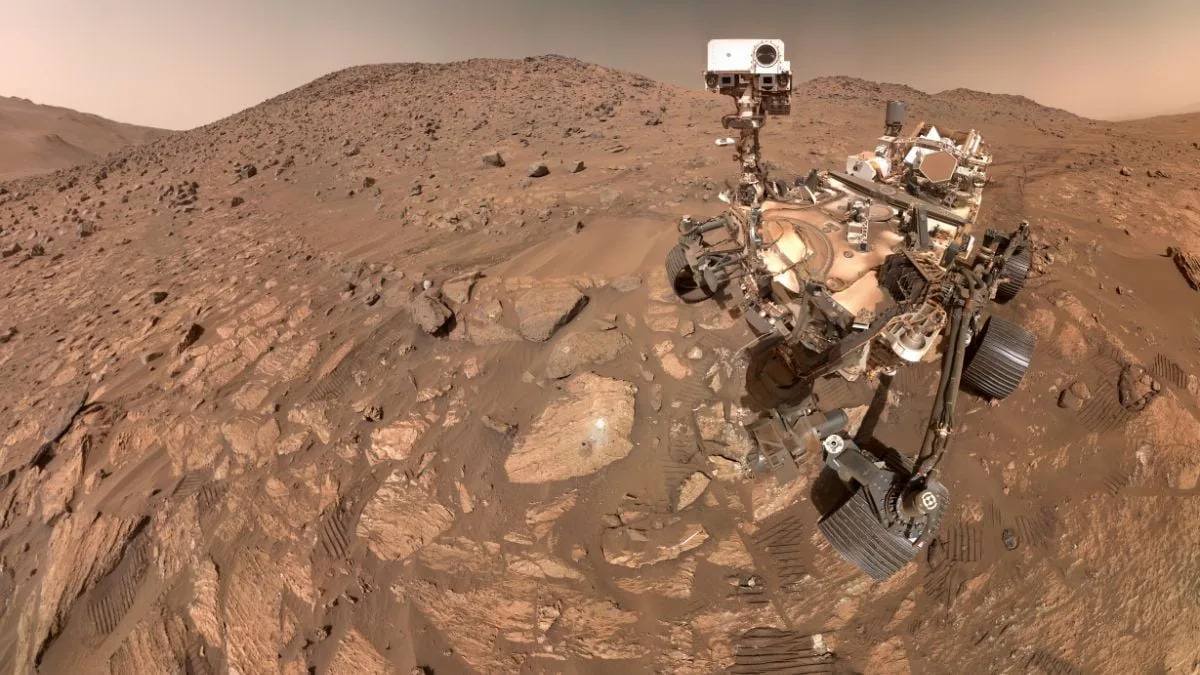
Since 2021, NASA's newest Mars rover, Perseverance, has been steadily exploring the site of an ancient lake: Jezero Crater.
Formed by a meteorite impact some 3.7 billion years ago, Jezero Island was a vast expanse of water and a river delta, while our rusty, dusty neighbor may have been a blue water world like Earth.
It is thought that this lake could have existed for many millions of years, potentially allowing various molecules, including those brought in by magma flows from Mars's enriched interior, to form the chemical precursors of life.
In a new study, scientists describe how they used the SHERLOC instrument on board the Perseverance spacecraft to study some intriguingly complex carbon compounds found in rocks at the Jezero deposit.
What they found was astonishing.
«"The detection of macromolecular carbon on the dust-clear but otherwise unprepared surface of the Cheyawa Falls rock represents the most shallow detection of organic matter on the surface of Mars," Kyle Uckert, an astrobiologist and instrument scientist at NASA's Jet Propulsion Laboratory, told ScienceAlert via email.
«"This suggests that these organics may have been exposed to the environment relatively recently or were protected by minerals with photoprotective properties.".
The researchers found this macromolecular carbon (MMC) in two rocks at the Bright Angel outcrop in the Neretva Valley, the riverbed that fed the western delta of the Jezero crater.
One such rock was the Cheyawa Falls mudstone, which contained intriguing leopard-like spots that sparked debate about their possible biological origin.
In other words, the researchers don't know where the Martian MMCs came from, and they also don't claim that they indicate life on Mars.
«"The presence of organic matter on Mars does not necessarily imply the presence of biological processes," Uckert explained.
«"The Perseverance rover's payload does not allow us to assess whether organic compounds are the result of biological or abiological processes. We cannot conclude that biology played any role in the formation of the organic carbon described in this study.".
Although the MMC described here cannot be attributed to any specific mechanism of formation, the researchers presented several possible options for its origin.
It may have been delivered to Mars with particles of interplanetary dust or as part of meteorites.
On the other hand, it can be formed on site as a result of abiotic processes such as volcanic, electrochemical or hydrothermal effects on rocks.
Of course, this also means that this work cannot rule out the most exciting possibility from an existential point of view: biological synthesis in situ .
Determining the source of these interesting organics will require highly sensitive analysis that can only be performed on Earth, so organizing a sample return mission from Mars will be vital.
On the topic: Scientists split a Martian meteorite and discovered a big surprise.
Thus, the excess of organic matter on Mars represents a shocking situation on a universal scale.
If we can eventually prove that life existed on (at least) two planets in our little corner of space, then perhaps it could have arisen elsewhere in the universe, too.
But in a universe so vast and diverse, who knows what these signs of life might look like—or whether we'll live long enough to see them?.
The results of this study are published in Science Advances journal .
ScienceAlert articles are written, fact-checked, and edited by humans; they are never generated by artificial intelligence. Don't miss a single article; subscribe here.
Related news
-
Scientists may have detected the first signs of a black hole's event horizon.
-
A scientist claims that the largest extinctions on Earth could have had a hidden cosmic cause.
-
The chemical composition of interstellar comet 3I/ATLAS is unlike anything we have ever seen.