








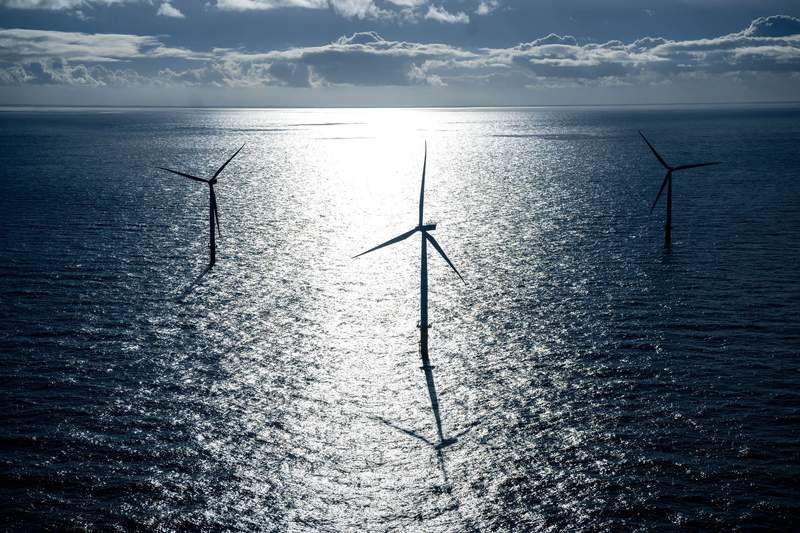
Offshore wind projects could potentially cover 11% of the North Sea area by 2050, according to new UK research.
A study led by Heriot-Watt University has presented a scenario of how offshore wind power could change the North Sea by 2050.
The analysis showed that if all current political commitments to offshore wind development were fulfilled, approximately 111 TP3T of the basin's water area would be within the boundaries of wind farms.
This represents a projected increase from approximately 1% of the current basin area to approximately 11% by 2050.
The researchers said this is more of a forecast than a prediction of where wind farms will be located in 2050.
Dr Simon Waldman, Associate Professor of Energy Technology in the School of Energy, Geosciences, Infrastructure and Society at Heriot-Watt University, said: "Our scenario shows the scale we would face if every country built the offshore wind capacity they promised.".
«It is important to be clear that this is not a forecast of what the North Sea will look like in 2050, it is merely a projection based on available data and the national ambitions we are pursuing today.».
The analysis shows that current political commitments call for the installation of a total of around 19,400 offshore wind turbines in the North Sea by 2050, including those already built.
The study looked at both existing offshore wind farms and projects already in the national development stage in all seven countries located in the North Sea: the Netherlands, Belgium, Denmark, Germany, the UK, Norway and France.
Where necessary, hypothetical wind farms were added to the model to bring each country's total capacity into line with its stated commitments.
Waldman said the study was originally launched to understand the environmental impacts of large-scale offshore wind deployment.
He continued: "We initially began this work because we wanted to understand the environmental impacts of a very large-scale deployment of offshore wind farms. To do this, we needed a plausible set of turbine locations, and such a set simply didn't exist at the time.".
«Since the project began, national ambitions have grown in response to global events, so we have updated the dataset to reflect the higher goals governments are now setting for themselves.».
By 2030, the UK is projected to remain the largest country developing offshore wind power in the North Sea, with around 4,200 turbines in operation.
Germany is followed by around 2,700 turbines, and the Netherlands by approximately 1,700.
Wind power is expected to increase in these three countries by 2050, with the UK estimated to have around 6,300 wind turbines, Germany around 4,300 and the Netherlands just over 4,200.
The Netherlands is projected to become the most intensively used national area, with offshore wind farms expected to occupy around 19% of its North Sea waters by 2050.
Belgium ranks second with a projected rate of approximately 18%, ahead of Denmark (approximately 15%) and Germany (approximately 14%). It is followed by the United Kingdom (approximately 9%), Norway (approximately 8%), and France (approximately 7%).
Combined, planned and operating offshore wind energy installations will occupy approximately 58,500 square kilometres of the North Sea, increasing from approximately 1% of the current basin area to around 11% by 2050.
Waldman added: «To build this scenario, we brought together a wide range of international data from the marine and energy sectors, from national targets and spatial planning plans to seabed depths, wind and wave data, existing infrastructure and projected turbine technologies, to create a realistic picture of what current ambitions could mean in practice.».
«When locating our planned future wind farms, we have tried to avoid shipping lanes, conservation areas, existing offshore cables and pipelines, and other objects.».
«"This demonstrates the scale of activity we will face if offshore wind development continues as promised, and the practicalities that come with it.".