








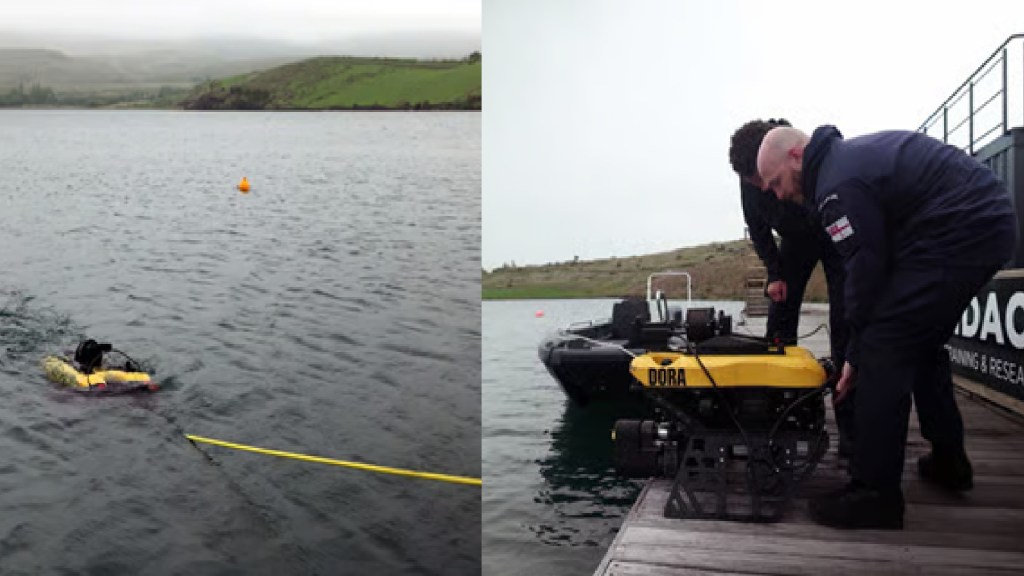
The Royal Navy is preparing to deploy the Video Ray Defender Viper autonomous underwater robot to the Strait of Hormuz, where naval mines pose a constant threat to commercial and military shipping. The system is designed to detect and destroy mines in turbid, low-visibility waters without exposing divers to risk.
What does the Defender system do?
The Video Ray Defender Viper system is a single-use mine countermeasure system—a torpedo-shaped robot that homes in on a mine, attaches to it, and detonates a shaped charge to destroy the threat.
The Royal Navy has called the system "phenomenal" for its ability to operate in the low-visibility conditions typical of the Persian Gulf, where suspended particles and turbid waters regularly reduce underwater visibility to near zero. The Defender system is among numerous pieces of equipment loaded aboard the support vessel RFA Lyme Bay before its deployment to the Middle East.
The device is launched by divers or from a surface vessel and autonomously navigates to a target identified by sonar. Once it approaches a mine, it does not return—the robot is destroyed during the neutralization process.
This disposable design eliminates the delays and personal risk associated with manually installing an explosive charge onto a mine casing by a diver.
Underwater communication is one of the most challenging engineering challenges for systems of this class. Acoustic modems, which transmit data as sound waves rather than radio signals, allow operators to communicate with autonomous vehicles at depth—a limitation explored in recent work on compact antenna systems for underwater robots capable of maintaining communication at ranges of over 2,000 feet.
Why the Strait of Hormuz Matters
Approximately 20 percent of global oil trade passes through the Strait of Hormuz, a 21-nautical-mile-wide chokepoint between Oman and Iran. Mining the strait, or the credible threat of doing so, is a well-documented element of Iran's asymmetric naval strategy. The US Navy estimates that several commercial tankers were damaged by suction cup attacks in the region in 2019.
Traditional mine countermeasures methods rely on specialized minesweepers—slow, acoustically silent vessels that deploy sonar and teams of divers. This process is effective, but labor-intensive and puts personnel at risk.
The introduction of the Defender system shifts some of this work to an autonomous platform that can be kept on standby aboard a surface combatant or patrol vessel without the need for a dedicated minesweeper hull.
Technical and operational limitations
Disposable neutralizers like Defender are most effective after the mine has been accurately identified and localized. The detection and classification phase still relies on sonar—typically a hull-mounted or towed system, or a separate remotely operated vehicle equipped with high-frequency sonar. If the sonar data quality is poor, misidentifying a target means wasting the asset without the possibility of recovery.
The system also addresses one category of mine threat: moored and bottom mines visible to sonar. Mines that respond to magnetic, acoustic, or barometric signals and are embedded in seabed sediments present a more complex detection challenge, which no existing system currently addresses definitively.
Logistics poses an additional constraint. Since the Defender is a consumable item, prolonged mine clearance operations require a constant supply chain for the vehicles themselves, increasing the operational burden in a theater of operations already stretched across long supply lines.
Autonomous systems in naval mine warfare
The Royal Navy's shift to autonomous mine countermeasures is in line with a broader trend in NATO navies. France, Norway, and the United States have already implemented or are developing similar unmanned underwater vehicle programs to reduce the need for manned mine-clearing vessels.
The UK's Maritime Autonomous Systems programme, under which Defender is being developed, aims to create a family of systems that encompass detection, classification and neutralisation as separate but interoperable capabilities.
The Ministry of Defence has not yet confirmed whether the Defender amphibious assault ship will be permanently deployed to the Persian Gulf or used in exercises with allied naval forces.
If the mission in the Strait of Hormuz is carried out in one of the most challenging operational conditions ever encountered by an autonomous mine countermeasures system outside of wartime.