








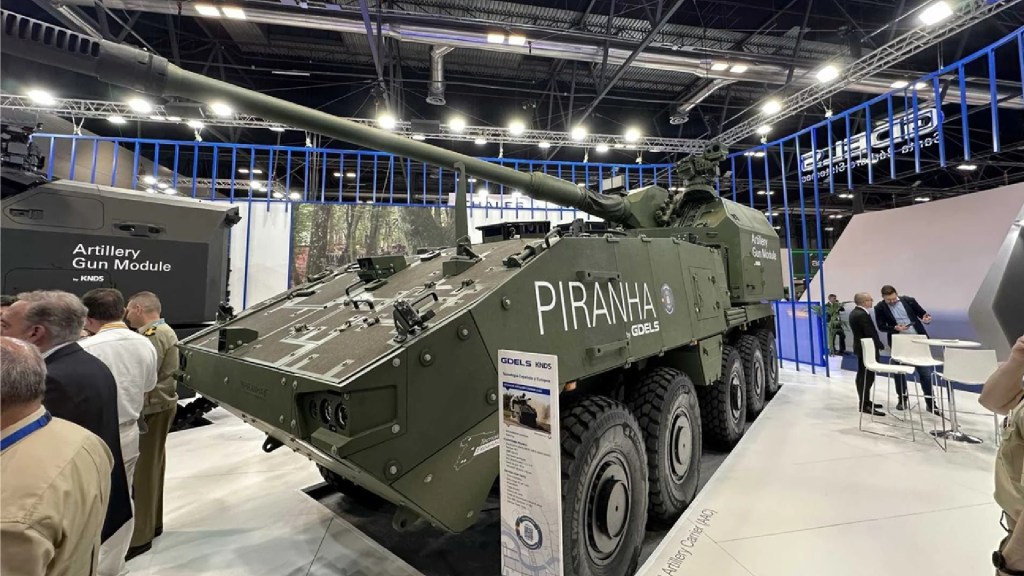
General Dynamics European Land Systems (GDELS) and KNDS have jointly developed a wheeled self-propelled howitzer by mounting a KNDS 155mm Autonomous Gun Module (AGM) on the chassis of a GDELS Piranha 10×10 armoured vehicle.
The result was a platform that meets NATO requirements for artillery interoperability while providing strategic and tactical mobility unavailable to tracked systems.
«Piranha 10x10 as an artillery carrier
The Piranha 10×10 armored fighting vehicle is a 30-ton wheeled armored fighting vehicle, already adopted by several NATO armies in both armored personnel carrier and fire support configurations. Its eight-wheel configuration and independent suspension allow it to reach speeds in excess of 100 km/h, making this wheeled howitzer variant closer in speed to motorized infantry than traditional self-propelled artillery.
The ability to airlift this platform on large military transport aircraft is an operational aspect that tracked howitzers like the PzH 2000 cannot easily provide without significant preparation.
GDELS chose the 10x10 variant precisely because the additional axle and payload margin is necessary to absorb the recoil and combat weight of a full 155mm artillery system, including automatic reloading mechanisms and onboard ammunition storage.
155 mm AGM and its technical parameters
KNDS developed the AGM as a modular artillery turret designed for integration onto various vehicle platforms. The gun fires standard NATO 155mm/52-caliber ammunition, making it compatible with the entire family of Western precision-guided munitions, including the Excalibur and SMArt 155 projectiles.
The module is equipped with an automatic reloading system designed to reduce crew size and maintain a practical rate of fire without manual loading under armor. Exact data on the rate of fire and magazine capacity from the manufacturers have not been independently confirmed at this stage, so the exact figures should be considered preliminary until official technical specifications are published.
The AGM design separates the weapon module from the carrier, theoretically allowing the same turret to be fitted to different chassis families as requirements change, reducing long-term development costs for partner nations.
Trade-off between mobility and survivability
Wheeled artillery platforms come with a design trade-off: the reduced armor protection inherent in a road-optimized wheeled chassis means the platform relies on hit-and-run tactics and fire dispersion rather than passive protection.
In intense, peer-to-peer conflicts where counter-battery radars and loitering munitions are widely used, reliance on speed and redeployment is both the system's primary defense and its greatest operational vulnerability.
Integration also raises questions about ground pressure and maneuverability on soft ground. A 30-ton wheeled vehicle carrying a 155mm recoil system must withstand ground loads on all ten wheels during firing, and the effectiveness of bladed or stabilizing systems on various surfaces remains a subject of testing at this stage of development, rather than a solved engineering problem.
For readers interested in the broader evolution of wheeled armored platforms, General Dynamics' Stryker program offers an important starting point for understanding how wheeled combat vehicle families have expanded their capabilities to fill roles previously reserved for tracked systems.
NATO Procurement Context
Several NATO member countries are currently seeking to replace their Cold War-era self-propelled artillery amidst limited defense budgets. A wheeled 155mm system, using the same logistics chains and crew training methods as the existing Piranha-class howitzers, could reduce overall lifecycle costs compared to purchasing a completely new tracked howitzer.
The GDELS-KNDS collaboration is positioned specifically for the NATO market, targeting armies that are already using Piranha variants or evaluating wheeled, protected mobility solutions.