








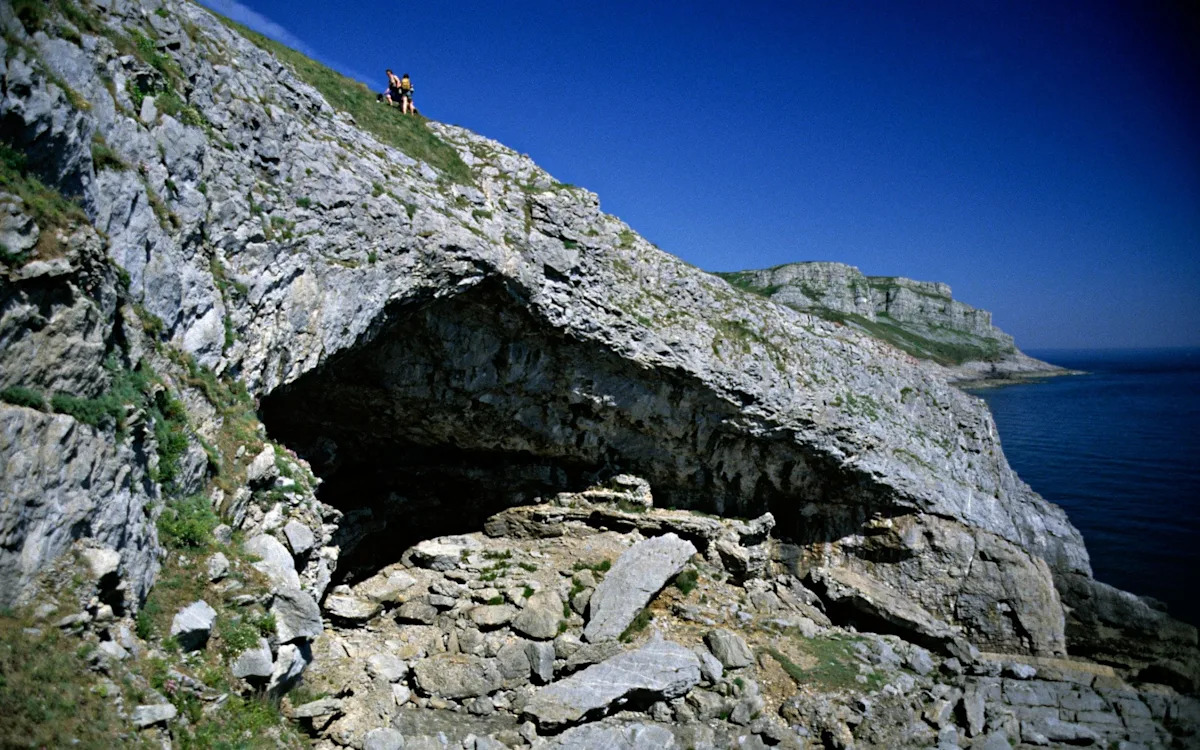
A study has found that a striped stone in Wales is the earliest example of rock art in Britain.
It has long been thought that marks on the walls of Bacon Hole Cave, near Mumbles in south Wales, were the result of a natural mineral in the rock.
However, analysis using the latest scientific dating techniques has shown that the stripes represent rock paintings dating back 17,100 years, making them the oldest example in northwestern Europe.
Red stripes on the walls of Bacon Hall, shown in photographs from 1913 (left) and 2024 (right).
Dr George Nash, a British prehistoric art expert from the University of Liverpool who led the research team, told The Guardian newspaper: "These are the earliest examples of prehistoric art we have in Britain.".
«"After 1928, it was never considered to be rock art, and it was impossible to date it because the scientific tools we have today didn't exist back then.".
«"We used uranium-thorium dating to identify the pigments. We have evidence that these rock art paintings are 17,100 years old, making them the oldest rock art in the British Isles.".
«"I was amazed that we were able to date the find and analyze the pigments. This is a fascinating discovery, with significant implications for understanding what happened in Wales in the distant past.".
The cave paintings, consisting of ten horizontal red stripes on the right wall of the cave, were first discovered by Professors William Sollas and Henri Breuil in 1912, when they were described as "the first example of prehistoric cave painting ever discovered in England.".
However, the authenticity of this phenomenon was disproved in 1928, when scientists declared that the red streaks that gave Bacon Hole its name were actually red oxide seeping through the rock.
New analysis of the bands has shown that they are a mixture of calcite, possibly originating from the region's limestone rocks, and clay residue, consistent with a "pigment composition.".
Dr George Nash says the dating of the bands is crucial to understanding prehistory in Wales (Rock Art Network).
A study published in the journal Quaternary concluded: "Based on both field observations… and laboratory examination of pigment samples, it is clear that the pigmented lines were intentionally created by humans and not by natural processes.".
The authors added: "Based on the available data… we agree with the original interpretation proposed by Breuil and Sollas in 1912… The drawn lines are horizontal and equally spaced, indicating a deliberate and structured pattern." The study also revealed that the paint was applied with a finger.
Bacon Hole Lake is located in the limestone cliffs of the southern Gower Peninsula, overlooking the Bristol Channel.
The area is managed by the National Trust for Wales and is classified as an Area of Outstanding Natural Beauty. However, archaeologists argue that it should be designated a "protected monument," which would provide it with enhanced protection.
The authors believe the rock art was created in the Upper Palaeolithic, when Wales was emerging from the severe cold of the last Ice Age.
«"During this period, the climate gradually changed from a nearly uninhabitable frozen landscape to a treeless periglacial environment with sparse vegetation," they said.
«"The area now occupied by Bristol Channel, where Bacon Hole is located along the north coast, likely provided a favourable grazing area for migrating megafauna during the summer months.".
«"At the same time, Bacon Hole Cave and other caves along what is now the southern coast of the Gower Peninsula could have provided suitable habitats for groups of hunter-fisher-gatherers.".
The research was carried out by First Art in collaboration with scientists from the Universities of Southampton and Swansea.
Until now, no rock art has been discovered in Britain as ancient as those in southern Europe, where some examples date back more than 30,000 years.
In 2003, more than 80 engravings and reliefs, believed to be around 13,000 years old, were discovered in Cresswell Crags Caves in Derbyshire.
Other examples include artwork discovered by Dr Nash in 2010 in Cathall Cave, Parkmill, about two and a half miles from Bacon Hole, which is estimated to be 12,500–14,500 years old.
Try The Telegraph today for full free access. Discover their award-winning website and essential news app, plus helpful tools and expert guides on finance, health, and leisure.