






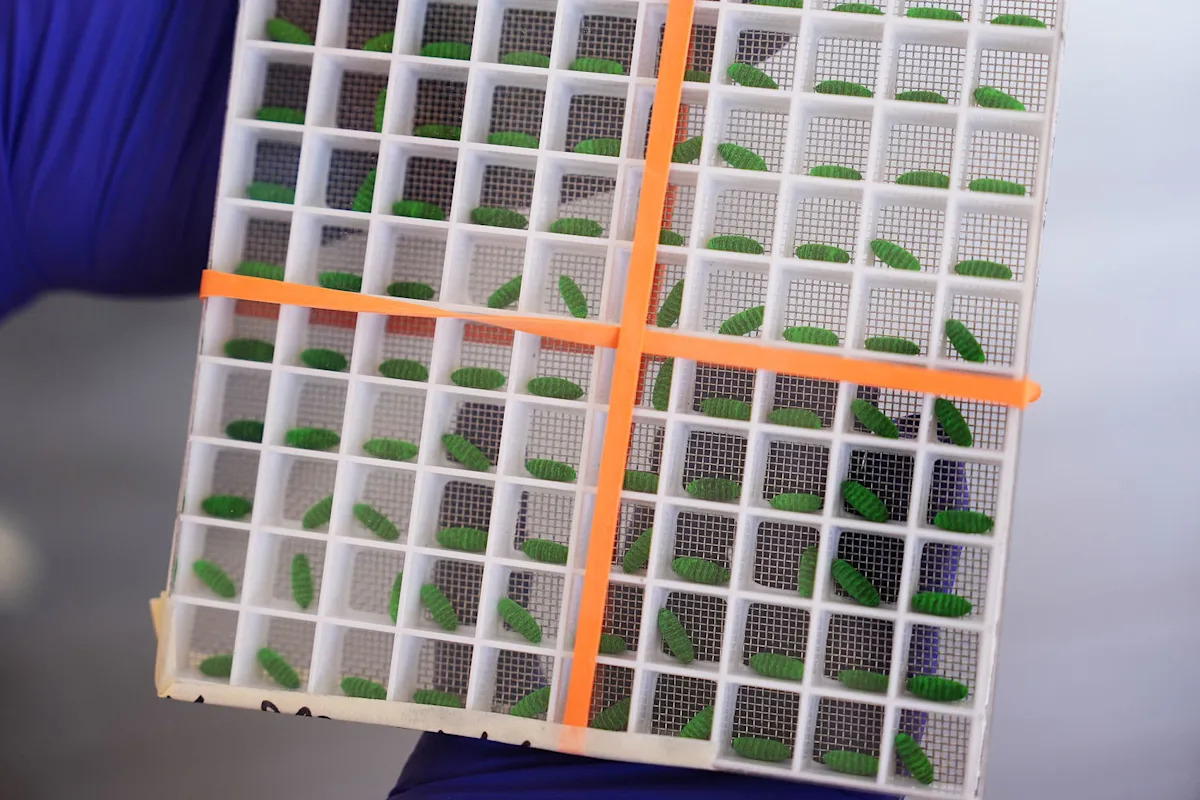
The United States spent more than half a century and hundreds of millions of dollars trying to push the flesh-eating New World blowfly as far from its borders as possible. Now it's back.
This species is capable of feeding on the tissues of any warm-blooded animal, but it poses a particular threat to livestock and is often fatal in cattle. Some environmental bioethicists have openly debated the morality of deliberately eradicating this blowfly.
«"There are species that are worth considering for complete eradication, and I think the screwworm is one of them," said Gregory Kabnick, a senior fellow at the Hastings Center for Bioethics.
The Department of Agriculture announced Wednesday that a calf in Texas had been found infected with the New World screwworm larvae—the first such detection in U.S. cattle during natural spread since 1982. On Friday, the agency reported a second case, discovered approximately six miles from the initial infestation. This discovery highlights the alarming resurgence of this species and the failure of containment efforts in the U.S., repeating a decades-long battle the country once faced.
Experts said the US will employ virtually the same tactics as in the late 1950s, when the government launched an aggressive multinational campaign against the blowfly. Since female blowflies mate only once, the strategy involves mass-rearing sterile males and releasing them into the wild, where they serve as dead-end breeding grounds.
«"It's a fantastic strategy. It's worked and will continue to work," said Chad Cross, a professor of parasitology at Texas Tech University's School of Veterinary Medicine.
He added that the new case in Texas "is a stark reminder of how quickly we need to act to prevent further spread of infection.".
The blowfly is not a worm at all, but a species of flesh fly native to the southern United States. These flies are attracted to rotting, neglected wounds. Females can lay 200 to 300 eggs, which hatch into screw-like larvae that burrow into tissue.
«"The larvae hatch from the eggs and eat the flesh of warm-blooded animals," says Philip Kaufman, a professor of entomology at Texas A&M University. "It's a pest of all our livestock, most wild animals, and even our pets: cats, dogs, and ourselves.".
Blowfly larvae—or maggots—have specialized mouthparts that allow them to burrow into the animal's flesh and penetrate deeper. As the larvae multiply, the wound develops into an open, rotting ulcer on the animal's skin, sometimes attracting other flies with the smell of rotting flesh. If the larvae are not removed and the animal is not treated with a larvicide and antibiotics, the infection is usually fatal.
A cow grazes on June 2 in Quemado, Texas. (Brandon Bell/Getty Images)
For humans, infections are extremely painful, although they are rare.
«"It eats away at your tissue, whether it's muscle, fat, or skin," Kaufman said. "It's almost impossible not to know you have this problem.".
Kaufman said blowflies are found only in the southernmost regions of the United States, although they can be found in more temperate climates in warm enough climates.
«"It survives in favorable weather conditions in the Midwest, but it can't survive the winter," Kaufman said. "In South Texas and South Florida, it never gets cold enough to kill it.".
These were the primary habitats of this species in the United States until the 1960s, when the United States intensified efforts to eradicate the blowfly. Over the next four decades, factories and distribution centers were built in Florida, Texas, and Central America, producing and releasing hundreds of millions of sterile flies weekly.
Sterile flies are irradiated and released en masse to cover the area affected by the disease outbreak. Their presence makes it virtually impossible for wild female blowflies to find and choose a non-sterile mate. Without viable partners, the flies cannot lay eggs or reproduce.
The strategy worked: after cases dropped to zero in 1982, the US continued its campaign in Mexico and other Central American countries, pushing the screwworm further and further south.
«"It took us until about 2004 to eradicate it completely, all the way to the Panama Canal," Kaufman said.
But over time, he added, the US and its partners stopped investing in facilities that produced and distributed sterile insects in areas where screwworms had been eradicated.
«"As they open new plants in the south, they close plants in the north, so the plant in Texas closed, then the plant in Mexico, then the plant in Nicaragua, and we're left with just the plant in Panama," Kaufman said. "That plant is already worn out.".
For about two decades, the Darien Strait, a rugged, roadless rainforest on the border of Panama and Colombia, represented the geographical limit of the screwworm's distribution. However, in 2023, the screwworm outbreak began spreading north, first to Panama and Costa Rica, then to Mexico, and now to the United States.
«"Why did this come to light?" is the key question, Kaufman said. "Nobody really knows.".
Regardless of the answer, the US is investing again. The US Department of Agriculture is spending $750 million to build a facility in Texas that will produce approximately 300 million sterile blowflies per week. This is approximately three times more than is currently possible and comparable to what was produced in the 1960s. However, the facility won't begin operations until the end of 2027, and it will take longer to reach full capacity.
Until the facility is operational, the risk of a disease outbreak remains high. The U.S. Department of Agriculture estimates for 2024 that a large-scale maggot fly outbreak could cost the Texas economy approximately $1.8 billion annually due to livestock losses, veterinary costs, treatments, and additional labor.
While the goal is to eradicate the screwworm in the United States and Central America, some researchers believe the species' complete eradication should be considered. In 2024, a group of bioethicists, conservationists, and scientists met to discuss whether it would be worthwhile to modify the sterilization method and use genetic modification to introduce lethal genes into the screwworm gene pool, thereby dooming the species. The group published its position in the journal Science last year.
According to the authors, the screwworm has caused enormous suffering to livestock, which humans are responsible for caring for. The infections it causes are slow-growing and painful for both animals and humans, the article states, and it is unclear what value or benefit this species provides to the environment.
Bioethicist Kabnick said the group consisted of people predisposed to extolling the interconnectedness of life and the preservation of species. And yet, "We concluded that there may be cases where this makes sense.".
The researchers were largely speculating—the genetic modification technology they could use to eradicate the blowfly hasn't been tested on a large scale and isn't ready for use. If it does become feasible, it would be a major decision that could set a dangerous precedent, Kabnik said.
«"These things are not ready for release yet," he said.
This article was originally published on NBCNews.com.