








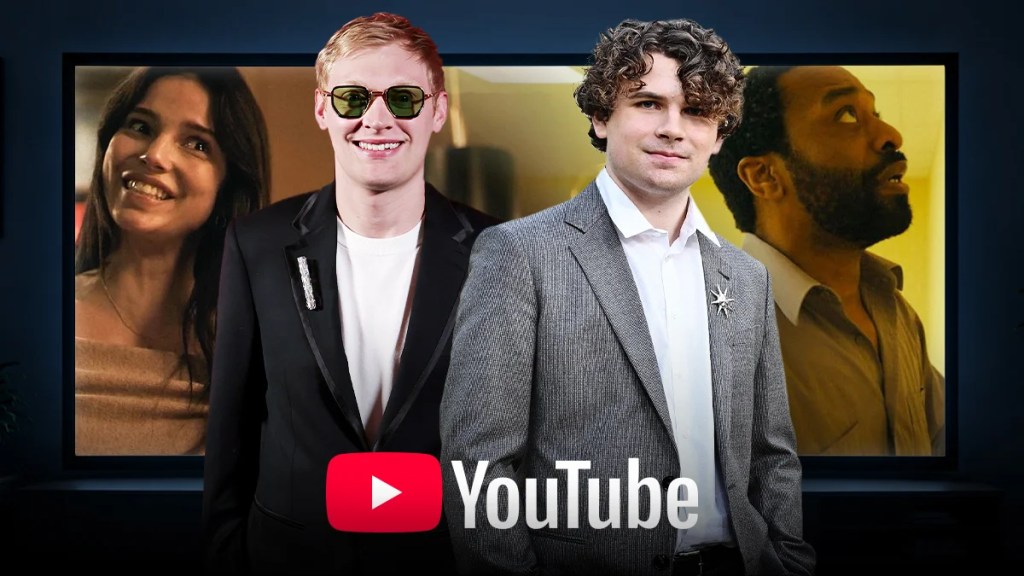
For years, Hollywood executives have been trying to get members of Generation Z to go to the cinema regularly. It turns out that a significant part of the solution lies in a couple of Gen Z directors who are redefining Hollywood and opening its eyes to a potential source of new talent.
The incredible success of A24's low-budget films "Behind the Scenes" and Focus Features' "Obsession," which have grossed a combined $185 million (and counting) at the U.S. box office against a production budget of $11 million, represents a rare instance of young audiences enthusiastically watching these films in theaters. And while past Gen Z hits like "Five Nights at Freddy's" and "The Minecraft Movie" were big-budget studio productions, these two horror films were created by 26-year-old Curry Barker and 20-year-old Kane Parsons, both of whom built their careers on YouTube.
«"Film schools are no longer where these kids learn their craft," one agent told TheWrap. "The technology of YouTube and social media allows them to learn how to write, direct, produce, and edit their own stories at a much younger age than previous generations.".
The success of these films has sparked speculation about whether YouTube could become the next major channel for attracting talent to Hollywood, especially for a generation of filmmakers who, until this weekend, haven't had the same opportunities to make their mark on the big screen as previous generations did in their 20s. But it's worth remembering that the path from the internet to the big screen is much older than it might seem.
While this process has long been established, the creative shift among Generation Z directors like Parsons and Barker lies in their complete immersion in the YouTube vlogger space long before they even ventured into filmmaking. While Hollywood veterans have marveled at countless panels about how high-quality films can be created using an iPhone and edited using inexpensive software, this generation grew up exclusively in this world and has a more intuitive understanding of how to navigate it.
«"You can hone your craft and test reactions in real time. Filmmakers no longer have to spend all day studying theory or waiting for someone to approve their work. Now it's all about how content is created online," one manager told TheWrap.
An old pipeline is attracting attention again.
James Wan, who worked with Parsons as a producer on the film "Behind the Scenes," understands Parsons's current state well. He was 27 when his debut feature, "Saw," launched not only his career but also the wave of gory horror films in the 2000s, as he grew up in a family of millennial filmmakers who used digital cameras to shoot their short films and computers running Premiere Pro to edit them.
Now with his own horror production studio, Atomic Monster, Wan and company president Michael Clear worked with Parsons to bring his vision of a fluorescent-lit hellscape to theaters. But this isn't the first time a YouTube short has captivated him enough to turn it into a feature.
«"The very first film Atomic Monster produced was 'Lights Out,' and it all started with a YouTube short that David Sandberg made in 2013," Wan told TheWrap. "It had the same core appeal as Kane's original short, 'The Backrooms.' It's a cool, simple concept: someone turns the lights on and off, and when the lights are off, there's a demon in there, and when the lights are back on, the demon is gone. And then it all gets closer as they keep turning the lights on and off.".
James Wan at the world premiere of "The Curse of La Llorana" during the SXSW Film Festival on March 15, 2019 in Austin, Texas. (Daniel Boczarski/Getty Images)
The short film "Lights Out" launched Atomic Monster into the Hollywood horror scene and launched the career of Sandberg, who went on to direct franchise films such as Annabelle: Creation, two Shazam! films for DC, and the video game adaptation of Until Dawn. Other directors who gained Hollywood attention through YouTube include Chronicle director Josh Trank, Predator: Wasteland director Dan Trachtenberg, and Bo Burnham, who all began their careers online before landing film deals within the Hollywood studio system.
But while these millennial filmmakers used their fame to tell different stories, when they transitioned to feature films, Parsons brought a wealth of experience and knowledge of what his fans liked, gained from his time on YouTube. Clear said the fan feedback from "Behind the Scenes" influenced how Parsons crafted his debut feature, even if it wasn't the primary factor guiding his creative decisions. He said that while Parsons wanted the film to be more character-driven than his shorts, he also shared what he learned from his fans' feedback about what truly resonated with his work and what made "Behind the Scenes" so terrifying.
«"He had very clear guidelines for how he wanted the film to feel and what his audience would and wouldn't want to see in a full-length version of these short films," he said. "It taps into a subconscious nostalgia, an idea that's almost like déjà vu, where you see these empty spaces and you feel like you've been there before, and there's something eerie and unsettling about that.".
It's this rapid feedback loop that explains why Wang is so optimistic about YouTube becoming a source of new theatrical talent, and not just for horror films, which, thanks to their low-budget production capabilities, are better suited to attracting internet-bred talent.
«"I think comedy is truly the next wave because there are young filmmakers and comedians creating really funny viral shorts on YouTube, TikTok, and Instagram and building significant audiences," Wang said. "Hollywood will have to change its thinking because studios often want a big star in mainstream comedy. But I do believe the next Adam Sandler or Will Ferrell will emerge from the digital space, and it might be someone who also makes horror films, like Curry, because he was making sketches on YouTube even before 'Obsession.'".
YouTube is not the only factor
But while Barker built a YouTube following even before "Obsession" became one of the highest-grossing horror films of all time, Focus Features insiders said online notoriety wasn't a major factor in their decision to acquire "Obsession" at the TIFF film festival for $15 million last fall.
Although the Focus team knew Barker was known for his online projects, they, as they would at any festival, decided to have no preconceived notions about who Barker is as a director and what he could offer audiences. It was the film "Whiplash" itself, as well as the reaction to its midnight screening in Toronto—marked by its dark humor, brutal moral punishment, and a stunning performance from Indi Navarrete in the lead role—that sealed the deal.
When asked if his company was now more focused on YouTubers with filmmaking experience and feature film aspirations, one development executive told TheWrap that while high-quality short films on YouTube are among what they look for, he's wary of the idea of narrowing searches based on whether a creative has built a significant audience, like Parsons or "Iron Lung" director Mark "Markiplier" Fischbach.
«"Not all YouTube subscribers have the same preferences. 'Iron Lungs' worked because Markiplier managed to engage his fans as a content creator, not just with one thing, like playing video games in front of a camera," the project's director said. "I think Kane now has more fans as a director thanks to this film, but how many people bought a ticket because they liked the idea of 'Behind the Scenes,' which started out as a meme?"«
Chris Aronson, a former distribution executive at Paramount and 20th Century Fox and now a board member of Rentrak, was thrilled by the success of "Behind the Scenes" and "Whiplash" after years of studio meetings discussing how teenagers weren't going to the movies as much as they once did. He sees the success of Parsons and Barker as an opportunity for theaters to attract a new wave of loyal moviegoers who can support their business.
However, he also cautioned that comparing the current moment to the heyday of New Hollywood, when directors like Scorsese, Coppola and Lucas shook up a stagnant film industry in the 1970s, may not be entirely accurate.
«"Success is constantly being redefined, not just financially but creatively," Aronson said. "It's wonderful that these directors have found their way into theaters and achieved mainstream success, but we shouldn't assume that everyone who's part of this online creator community wants a big deal where Hollywood will give them $50 million for their next film. It makes sense to work independently and stay on a tight budget, where you don't have to worry about a studio looking out for you.".
That's one reason why Fischbach took a different route to getting Iron Lungs into theaters than Barker or Parsons, going the self-distribution route and grossing a total of $50 million, which, while not as big as Obsession or Behind the Scenes, allowed him and his team to take a larger cut of the profits while retaining ownership rights.
«"I understand that Iron Lungs is an exceptional case, but I think there are a lot of additional factors involved with some of these deals that make it so risky that there has to be a significant reward and success or it's just going to be a catastrophic failure," Fischbach told TheWrap back in February.
«"I think in a world like this, if independent filmmakers can more easily get their films into theaters and negotiate smaller terms, but through the internet, try to build their own small, concentrated fan bases, then they can make a profit because the stakes have never been so high that the studios have to match their profits," he added.
What's next?
Despite their much-needed success, films like "Behind the Scenes" and "Whiplash" captured Hollywood's attention because they met established criteria for success. But as films, filmmakers, and audiences become increasingly individualized in this post-monocultural world, the standards of success will also change.
Take, for example, the next major event to move from YouTube to theaters: Fathom's "The Amazing Digital Circus: The Final Act"—a theatrical showing of the final episode of the hit YouTube animated psychological drama series created by indie studio Glitch, premiering later this month.
Since this is the final installment of the series, the film won't gross nearly as much as "Behind the Scenes," with projected weekend grosses of $10-12 million.
However, this series marks Glitch's first attempt to bring its online animated shows, including the recently launched viral hit "Gameoverse" and the upcoming webcomic adaptation "Lackadaisy," to theaters in hopes of sparking a fan-favorite audience, similar to screenings of series like "The Chosen" or the finale of "Stranger Things." Unlike those shows, however, "Digital Circus" is produced entirely on YouTube, and its finale will be released on the site two weeks after its theatrical release, on June 19.
If this works for Glitch, it could become another way for independent creators to reach the big screen outside of the traditional Hollywood system. While YouTube may eventually attract more filmmakers like Kane Parsons to established studios, the channel isn't entirely focused on the old system.
Like Backstage, this place is creating something new, and no one knows exactly what it is yet.
Humberto González contributed to this report.
The article "Will YouTube Become Hollywood's Next Hit-Making Channel?" first appeared on TheWrap.