








Historical facts are like a time capsule transporting us into the past. They give us insight into ancient people and their way of life. However, some of these facts are actually myths. Despite this, people still believe them because they are popularized by novels, pop culture, and famous figures in our society. In this list, we debunk 10 such popular myths about history and set the record straight.
1. Myth: Ancient Greek and Roman sculptures were painted white.
Truth: Ancient Greek and Roman sculptures were originally painted with bright colors. Today, they appear white only because the original pigments have deteriorated.
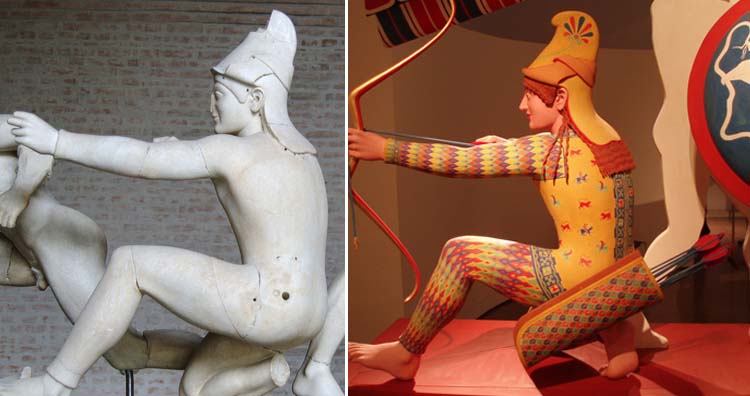
The dazzlingly white Roman and Greek statues and sculptures we know of weren't originally white. This is a lie attributed to us by history textbooks. The colorless statues discovered during excavations gave rise to an idea that became so popular that renowned art historians such as Johann Joachim Winckelmann (1717-1768) dismissed the existence of colorful Greek sculpture and architecture.
Contrary to popular belief, ancient Greek architectural sculptures were painted with vibrant colors, also known as polychrome (from the Greek words for "many" and "color"). However, due to intense weathering and other influences on the stone, the "polychrome" on ancient Greek sculptures and architecture has faded significantly due to burial conditions, aging, and excessive cleaning.
Recently, a group of archaeologists from Germany, led by Vinzenz Brinkmann and his wife Ulrike Koch-Brinkmann, as well as other specialists from the British Museum in England, using scientific methods, refuted this myth. (source)
2. Myth: Vikings wore helmets with horns.
Truth: The idea that Vikings wore horned helmets actually originated with a costume designer working on a production of Wagner's classic Norse saga.« The Ring of the Nibelung» in 1876.
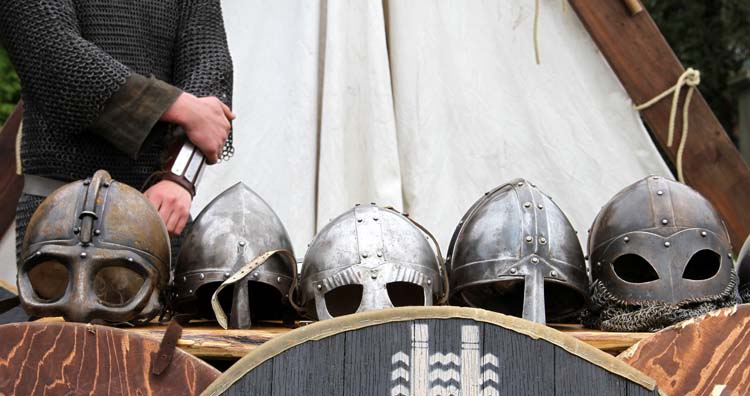
In every TV series about Vikings, we see them wearing horned helmets. At least, that's what we know from pop culture. But in reality, horned helmets were never part of their attire. Roberta Frank's article "The Invention of the Viking Horned Helmet" confirms the historically accepted view that Vikings never wore horned helmets.
This also allows us to understand how the mythical structure was attached to the Vikings' heads. The idea for this headdress belongs to costume designer Carl Emil Döppler, who included horned helmets in his magnificent costumes for Wagner's classic Norse saga, "« The Ring of the Nibelung » in 1876.
The opera's influential status made horned helmets a new trend among Vikings, despite their mythical nature. Germans were fascinated by classical Viking origin stories, prompting Döppler and other scholars to connect German and Scandinavian history. For Viking aficionados, headgear cannot overshadow the fascinating history of these peoples. (source)
3. Myth: Before Columbus's voyage to America, almost everyone in the world believed the Earth was flat. By discovering America, he proved that the Earth is a sphere. Truth: American writer Washington Irving lied in his book,« The Life and Travels of Christopher Columbus» , when he claimed that Christopher Columbus circumnavigated the globe to prove that the Earth was not flat.
Truth: The "flat Earth" theory hasn't been generally accepted since at least 600 BC. By the 1400s, almost everyone knew the Earth was round.

Christopher Columbus is widely known for his legendary voyage from Spain in 1492, when he crossed the Atlantic Ocean and disproved the then-prevalent notion of a flat Earth. This is a myth. Historians believe that the Earth's shape was well known to people centuries ago. Pythagoras, Aristotle, and Euclid wrote about the Earth as a sphere as early as the sixth century BCE. Ptolemy, during the height of the Roman Empire, 1300 years before Columbus's voyage, wrote "Geography" and considered the idea of a round planet to be fact. So who is to blame for this incredible historical lie? Jeffrey Burton Russell, a retired professor at the University of California, explains in his book "The Invention of the Flat Earth" how this myth was created in the 1800s by writers including Washington Irving and Antoine-Jean Letronne. In 1828, Irving wrote his fictional book, The Life and Voyages of Christopher Columbus, during his visit to Madrid. He extolled the false claim that Europeans learned of the Earth's spherical shape from Columbus's voyage, adding fictitious details to make the story gripping for readers. (source)
4. Myth: The common story that Isaac Newton was inspired to investigate the nature of gravity by an apple falling on his head is almost certainly apocryphal.
Truth: Newton himself only said that the idea came to him while he was sitting "in a contemplative mood" and "was caused by the fall of an apple.".

An apple falling on Newton's head inspired him to discover the force of gravity. This is what everyone was taught in school. But this story is incomplete. Newton was intrigued by the Moon's orbit around the Earth, which led him to hypothesize that the influence of gravity must extend over vast distances.
After seeing a falling apple in his family's garden, he spent many years trying to derive a mathematical explanation for the force of gravity. Newton's colleague, William Stukeley, who also wrote the first biography of Newton,« Memoirs of the Life of Sir Isaac Newton"» , approved this case.
Stukeley recalled a conversation with Newton after dinner in 1726 about the idea of gravity. In his manuscript, Stukeley writes: "In other discussions, he told me, he was in the same position as when the idea of gravity first occurred to him.".
«"Why does this apple always fall perpendicular to the ground?" he thought to himself. "It happened because the apple fell while he was sitting in a pensive mood." It's safe to say that his discovery of gravity was the result of many hours of painstaking research and insightful reflection, not just a single moment when an apple fell on his head. (source)
5. Myth: The "vomitorium" was a special Roman room where people could vomit between meals to make room for the next meal.
Truth: In ancient Rome, the architectural feature called the "vomitorium" was the entrance through which the crowd entered and exited the stadium, not a special room used to purge the body of food during meals.

The Romans are renowned for their extravagance, so much so that they even invented a mythical chamber to express their love of sumptuous food. No one can resist an exquisite Roman dinner party, and leaving the dining table is equally difficult. This is the "vomit chamber," where, according to rumor, the Romans vomited the remains of their hearty meals to make room for new dishes.
It was believed that vomitoriums allowed for continued feasting, unconstrained by the size of one's stomach, but this is all a hoax. The real history of vomitoriums is far less repulsive. For the Romans, vomitoriums were genuine Roman structures, serving as entrances and exits to stadiums or theaters.
These corridors got their name from the 5th-century writer Marcobius, who described how crowds of people rushed out to fill the empty spaces. His words were taken completely out of context.
In the late 19th or early 20th centuries, the concept of "vomitor" was completely misleading, possibly due to a linguistic error: "vomitor" sounds like a place where people vomit. It seems Marcobius's words were taken out of context. (source)