








It's been 25 years since the film was released. «Schindler's List, But even today, it still gives you goosebumps every time you watch it. The 1993 film was an emotional and personal project for director Steven Spielberg. He received no salary for directing it. He also didn't expect it to be a hit. He simply put forth enormous effort to tell the story of a man who demonstrated an unprecedented level of humanism. «Schindler's List» — is the story of Oskar Schindler, a German factory owner and Nazi who went to extreme lengths to save the lives of more than a thousand Jews whose names he compiled into a list. Here are some little-known facts about the creation «Schindler's List» .
1. The film is based on a true story. The main character, Oskar Schindler, is credited with saving the lives of 1,200 Jews during the Holocaust. The original list, long thought lost, was discovered in a suitcase in 1999 along with Oskar Schindler's written notes in the last apartment he occupied.

Oskar Schindler was a German industrialist and a member of the Nazi Party in 1939. He provided the German government with information on railways and troop movements. He acquired an enamelware factory in Poland and hired 1,700 people, 1,000 of whom were Jews. He managed to save his Jewish workers from deportation and concentration camps. Over time, he was forced to offer officials luxury goods as bribes to protect his workers.
In July 1944, as Germany began to lose the war, Hitler's army began closing the concentration camps and deporting the remaining prisoners. Many died in the Auschwitz concentration camp. Schindler managed to persuade officials to allow him to employ them in his factory, with the ulterior motive of saving his workers from certain death.
Oskar Schindler managed to save 1,200 Jews, 1,000 workers, and 200 prisoners from death in concentration camps at the Julius Madritsch textile factory. He continued to pay bribes until the end of the war in 1945. He spent his entire fortune saving the lives of these Jews. Schindler also helped 3,000 Jewish women find work in textile factories and escape from Auschwitz, thereby increasing their chances of survival. (source)
2. During the filming of Schindler's List, Steven Spielberg would ask Robin Williams to come to the set and talk on speakerphone to lift the spirits of the cast and crew. Spielberg also watched episodes every night. «Seinfeld» , to defuse the situation.

Making the film presented a personal challenge for Steven Spielberg. When he first expressed interest in the film, he felt he wasn't mature enough to handle the emotional aspects of the plot. So he decided to wait ten years before beginning production. But with the rise of neo-Nazism after the fall of the Berlin Wall, Spielberg decided to stop delaying and began work on the film.
When filming began, the atmosphere on set was somber. Spielberg focused on editing the footage for Jurassic Park every evening after filming to calm down. He even invited legendary comedian Robin Williams to the set to cheer up the cast and crew. Furthermore, before going to bed, Spielberg would usually watch one episode. «Seinfeld» , to lift your spirits. (1, 2)
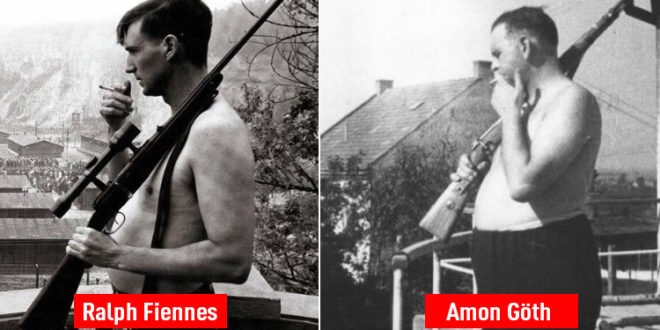
3. Holocaust survivor Mila Pfefferberg met Ralph Fiennes on set. Upon seeing Fiennes, she shuddered, as he reminded her too much of the real camp commandant, Amon Göth.

Amon Leopold Göth was the infamous Nazi commander of the Plaszow death camp. His brutal and merciless actions were brought to light by the film «Schindler's List» . The role was played by British actor Ralph Fiennes, who received a BAFTA award and an Oscar nomination for it.

Göth made life a living nightmare for the people in the camp. He beat them, shot them, and attacked them with trained dogs for no apparent reason other than his own amusement. He forced them to work mercilessly, day and night. So when one of the camp's survivors, Mila Pfefferberg, met Ralph Fiennes on a film set, she began to tremble. In his full SS dress uniform, Fiennes looked exactly like Göth, and the memory alone terrified her to the core. (source)
4. The cufflinks Oskar Schindler wears in the opening scene feature the Seabourn cruise line logo. They were a gift to Steven Spielberg from his cousin, who had taken a Seabourn cruise.
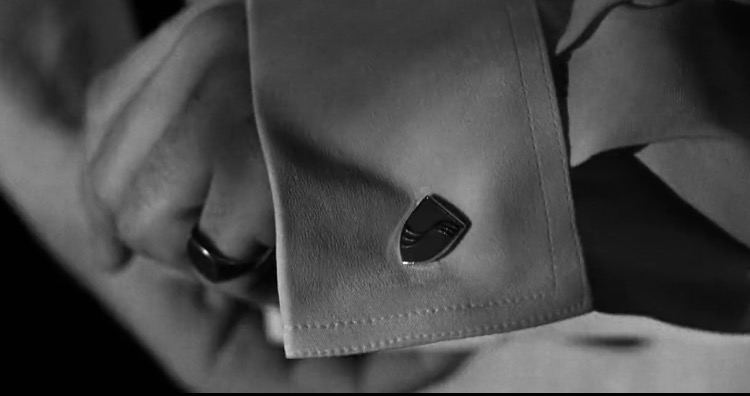
Oskar Schindler, played by actor Liam Neeson, was a well-dressed gentleman, as evident in his entrance scene. In it, he calmly lays out a change of jackets, ties, and cufflinks and emerges, dressed appropriately. The cufflinks he eventually wears actually belonged to Steven Spielberg. His cousin gave them to him after returning from a cruise on the Seabourn. (source)
5. When Oskar Schindler first visits the camp, he notices a boy being punished with a sign that says,« Jestem zlodziejem ziemniaków »" This translates to "I am a potato thief.".
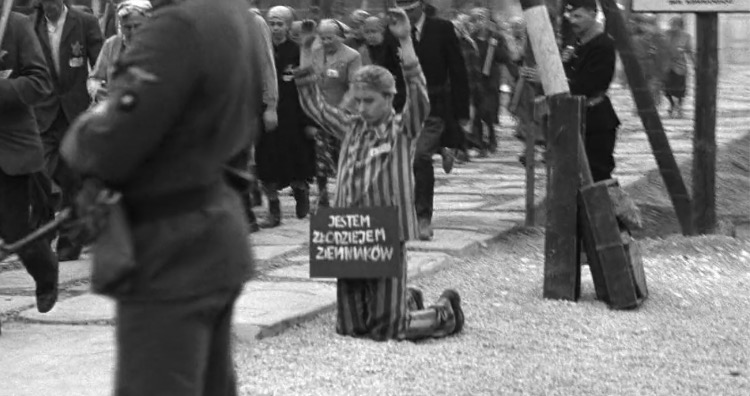
It's a reminder that in the camps, no crime, no matter how minor, went unnoticed or unpunished. When Oskar Schindler visits the Krakow camp, he notices a boy being punished with a board around his neck. The board reads:« Jestem zlodziejem ziemniaków »" Translated into English, this means "I am a potato thief.". (source)
6. There's a scene where children are forced into trucks. In an interview with the magazine Time In 2013, Branko Lustig recalled that recruiting children to perform songs for this stage was one of the most painful moments in his life.

Branko Lustig's job was to visit schools and recruit children for this scene. He went from school to school in Krakow, forcing the children to sing the song. Then he brought the children to the filming location to march and sing the song while being loaded into trucks. The most horrifying thing was that Lustig knew the fate of these little children who joyfully climbed into the trucks.
This was the only time during filming that Branko Lustig was so upset that Spielberg had to escort him off the set. (source)
7. Many believe that Steven Spielberg laid roses on Oskar Schindler's grave. But in fact, it was Liam Neeson.
The film's final scene features real Holocaust survivors alongside the actors who portrayed some of them. Each lays a stone on Schindler's grave, as is a Jewish custom. Neeson, however, places roses on the grave. According to the IMDB FAQ, Neeson did this out of respect and to show his pride in portraying such a great historical figure. (1, 2)
8. Steven Spielberg advised Olivia Dabrowska, the actress who played the girl in the red coat, not to see this film until she was 18. But Dabrowska saw it at 11 and was horrified and ashamed to have been a part of it. Later, at 18, she watched it again and understood why this film is so important.
The footage of the girl in the red coat is real. Audrey Hepburn told this story to Steven Spielberg during the filming of her final movie. «"Always"» in 1989. She told him she saw a little girl in a red coat at the train station. The girl was just walking around while other people were being loaded onto trains.
This scene made a strong impression on Spielberg, and he created it for his film. Although the girl in the red coat doesn't survive in the film, she did in real life. In real life, this girl was Roma Ligocka. When she met Spielberg, he was very surprised and delighted to see that she had survived.
Ligotska recalls that the day she saw the film, she sat down that evening to write her story. Her book, "« The Girl in the Red Coat» reflects her life in the ghetto and how she survived. (1, 2)
9. Steven Spielberg makes a cameo appearance as the liberated Jew Schindler among the hundreds of people crossing the field near the end of the film.

Well, we'll have to take IMDb's word for it, as finding Steven Spielberg among hundreds of people would be very difficult! (source)
10. In the scene where wealthy Jews are forced to leave their homes, a man stops to pick something up from the doorframe. It's a mezuzah—a vessel containing a sacred passage from the Torah. Jews have a custom of placing it on doorframes.
A mezuzah is a sacred parchment kept in a vessel and hung on the doorframe of a Jewish home. The sacred parchment, known as Clough , taken from the Torah and must be handwritten by a qualified scribe trained in Jewish law. Vessel for claf It can be handmade or purchased. Furthermore, there are no restrictions on the size and shape of the vessel.
Then sheet of paper The parchment is folded from left to right so that the first words appear first when unfolded. It is then inserted into the container. The container should not be sealed permanently, as the parchment must be checked twice every seven years to ensure it is in good condition.
In one scene of the film, a Jew removes a mezuzah from a doorframe. (source)