








According to the widely accepted "Big Bang Theory," the universe began 13.8 billion years ago, and 4.6 billion years have passed since the formation of our solar system. Stars, planets, black holes, and countless other objects have formed and disappeared. So far, we've discovered only a few of them, and we know far less about the cosmos than we'd like. But what we do know so far still astounds us, and here are some facts about the cosmos.
1. About 1% of the static on old televisions was leftover radiation from the Big Bang.

Known as the "cosmic microwave background radiation" (CMBR), the faint remnant radiation from the early stages of the Big Bang is considered the oldest electromagnetic radiation and is a crucial source of information about the early universe. It has a thermal spectrum similar to a blackbody at a temperature of just two degrees above absolute zero. Although its frequencies are in the gigahertz range, its peak frequency, being in the microwave range, is 160 gigahertz. A small portion of the radiation is in the megahertz range. Radiation at megahertz frequencies is what televisions and radios detect when tuned to an "intermediate" channel. (source)
2. The largest known star, CY Canis Majoris, has a radius 1,420 times that of the Sun, and if it were placed at the center of the Solar System, it would extend beyond the orbit of Jupiter.
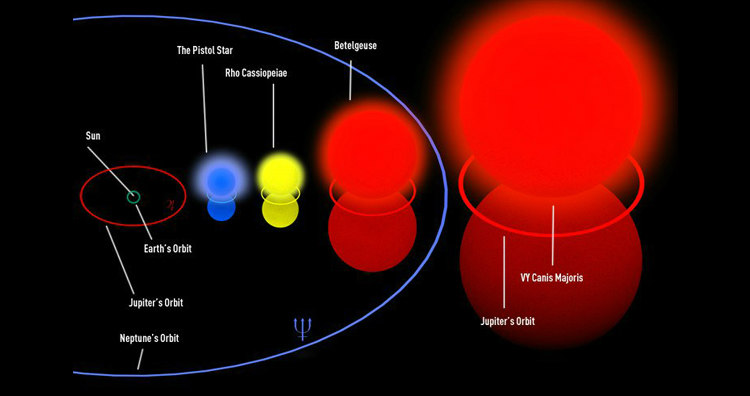
CY (Canis Majoris) is an extremely pulsating red supergiant located in the constellation Canis Major. One of the most massive and luminous of its kind, it was first observed by Jérôme Lalande on March 7, 1801. In the 19th century, it was initially thought to consist of at least six distinct components, indicating the presence of multiple stars, but visual observations and high-resolution imaging in the 20th century revealed that these are merely bright spots on the star.
The star is so large that, by some estimates, its surface would even cross the orbit of Saturn if it were at the center of the solar system. It would take a typical long-haul commercial jet, flying at 926 kilometers per hour, approximately 122 years to cross its radius. (1, 2)
3. Despite its rarity on Earth, the most common phase of matter in the Universe is plasma. The Sun, stars, and most interstellar matter exist in plasma form.
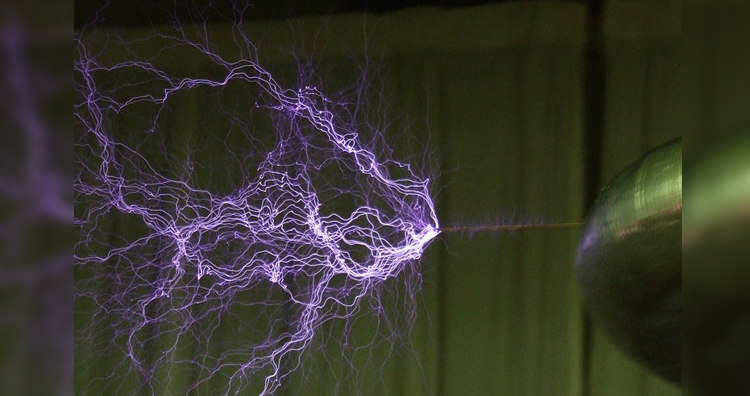
Plasma is one of the four fundamental states of matter, and unlike the others, it doesn't exist under ordinary conditions on Earth. It can be created by ionizing a neutral gas with heat or a strong electromagnetic field to the point that it becomes highly conductive. On Earth, artificially created plasma is used in many modern devices, such as plasma televisions. (source)
4. The largest asteroid is a massive rock called Ceres, with a diameter of nearly 945 kilometers (587 miles). It accounts for a third of the mass of the asteroid belt. It is so large that some consider it a dwarf planet.

Ceres orbits the Sun between Mars and Jupiter and is the 33rd largest known celestial body in the Solar System, as well as the only dwarf planet after Neptune. It was first discovered by Giuseppe Piazzi at the Palermo Astronomical Observatory on January 1, 1801, and was initially considered a planet. In the 1850s, it was reclassified as an asteroid. Ceres is composed of rock and ice and is the only known object in the asteroid belt to have acquired a spherical shape under the influence of its own gravity. (source)
5. The Sun accounts for 99.86% of the mass of the Solar System.

The solar system formed as a result of the gravitational collapse of a large molecular cloud 4.6 billion years ago, with most of the mass concentrated in the center, forming the Sun, and the rest becoming the planets and everything else. The Sun is a nearly perfectly spherical ball of hot plasma with a diameter of about 1.39 million kilometers, or 109 times the mass of Earth, and a mass of 1.98 x 1030 kilograms, or 333,000 times the mass of Earth.
Approximately three-quarters of the Sun is composed of hydrogen. The rest is primarily helium and heavier elements such as oxygen, iron, neon, and smaller amounts of carbon. After its formation, the Sun's center became so hot and dense that it triggered nuclear fusion—a process believed to be present in all stars—becoming the most important energy source for life on Earth. (source)