








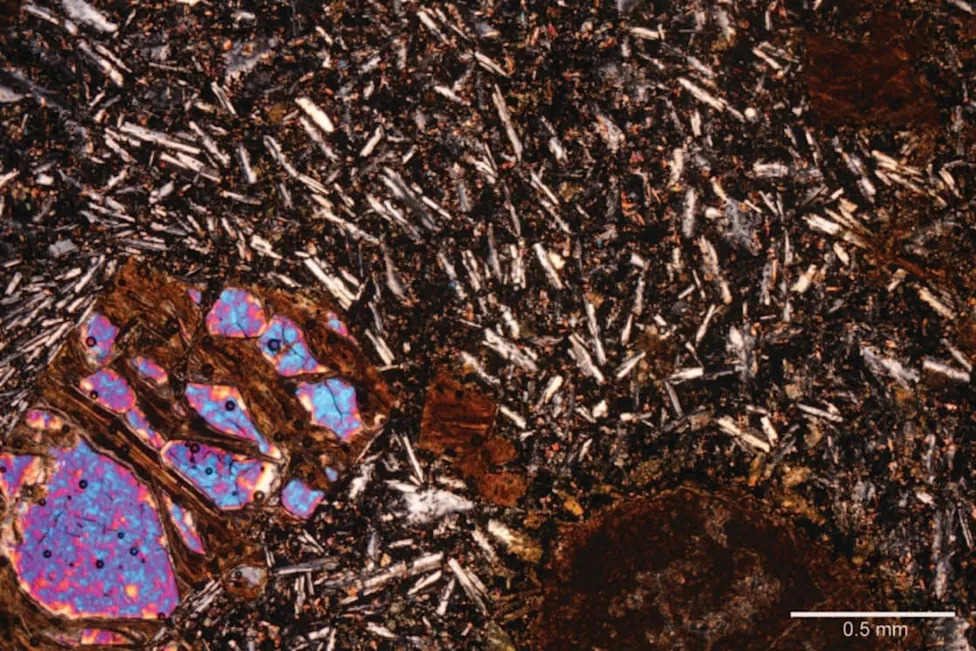
Basalt appears to have been of particular importance in the GBI, particularly for the production of large cutting tools such as hand axes and cleavers.
Ancient hominins living in Galilee possessed remarkable navigational accuracy, allowing them to locate specific rock sources for toolmaking, according to a new study.
Gesher Benot Ya'akov (GBY), one of Israel's most important prehistoric sites, dates back to approximately 780,000 years ago. Numerous Acheulean hominin settlements are preserved here along the shores of the Hula paleolake in northern Israel.
Excavations at this site, led by study co-author Professor Naama Goren-Inbar of the Hebrew University, previously uncovered stone tools made of flint, limestone, and basalt. Evidence of fire use, plant processing, animal butchering, and fish consumption were also found at the site.
Basalt appears to have been of particular importance in the GBI, particularly for the production of large cutting tools such as hand axes and cleavers.
Earlier studies have shown that making such tools was a complex task: hominins had to select large basalt slabs, work them into massive cores, break off large flakes, and then carefully shape these flakes into finished hand axes.
This process required planning, technical skill and detailed knowledge of the properties of basalt.
Where did the materials for their instruments come from?
The goal of the new study was to determine exactly where this basalt came from.
By comparing the chemical composition of the basalt tools with samples collected from nearby basalt flows, including material recovered from the Eshel Ya'akov borehole, which reaches basalt layers now buried underground, the researchers were able to match many of the artifacts to sources located within about a kilometer of the site.
Interestingly, the chemical composition of some of the tools matched that of basaltic springs that no longer exist on the surface. As the study explains, these springs may have been buried over time or eroded by millennia of tectonic activity.
Different types of basalt were used to make different tools.
Furthermore, chemical analysis showed that the instruments varied in type.
Some cleavers appear to have been made from basalt obtained from sources different from those used to produce most hand axes and giant cannonballs.
According to the study, early hominins specifically sought out basalt with specific properties suitable for making specific tools.
Furthermore, although the giant cannonballs were invariably associated with basalt found nearby or now buried underground, some of the cleavers found appear to have been made of basalt that did not match any local examples.
Even more remarkable is that the pattern of selective sourcing is repeated across multiple archaeological layers at the GBI, spanning tens of thousands of years, suggesting that this was not an isolated incident, but a tradition passed down from generation to generation.
Taken together, the findings paint a picture of early hominins as far more than mere scavengers, feeding on whatever came to hand.
Ancient hominins appear to have had detailed mental maps of their environment, understood how the landscape around them was changing, and applied this knowledge purposefully, choosing "the right stone for the right tool at the right time.".
The full results of the study were published in the journal Scientific Reports in early June under the title "Geochemical study of basalts reveals mining strategy at the Acheulean site of Gesher Benot Ya'akov, Transform Sea, Israel.".
The study was led by Dr. Tzachi Golan and Dr. Yoav Ben Dor of the Geological Survey of Israel, along with Professor Naama Goren-Inbar of the Hebrew University of Jerusalem, who has been directing excavations at the site for several decades.