








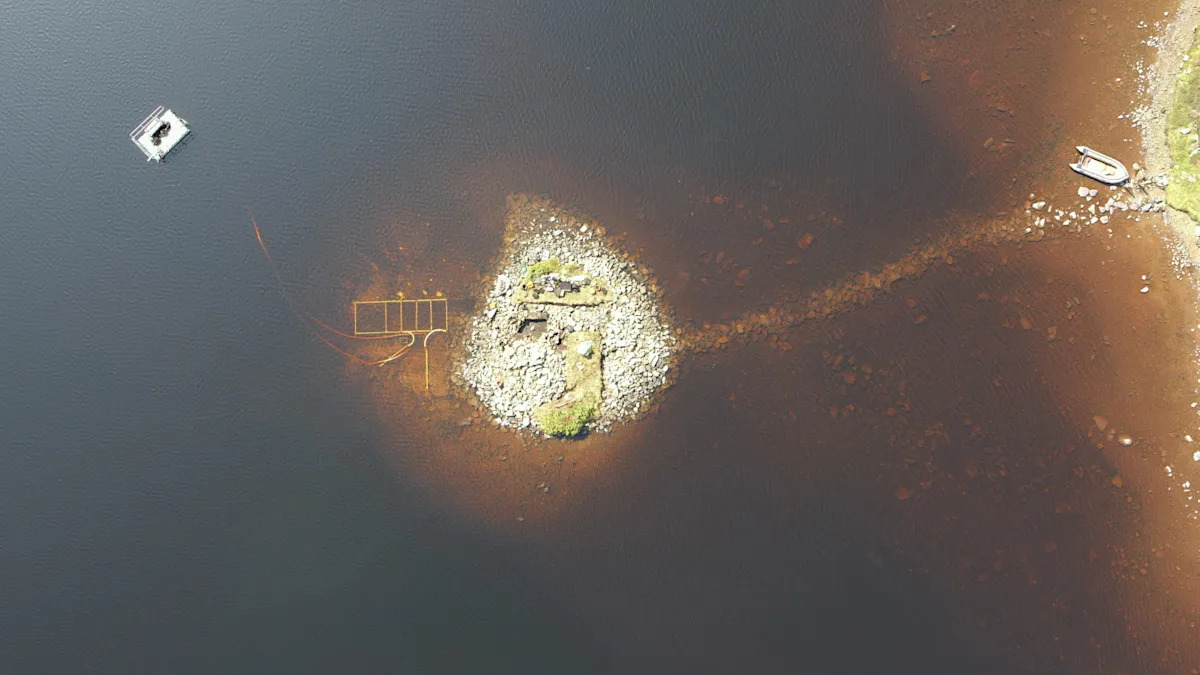
Mysterious and ancient man-made islands of wood and stone have survived amid Scotland's more famous megalithic structures, Roman forts, and 18th-century battlefields. Called cranogs, these islands initially raised doubts among archaeologists about their purpose, but they were reasonably certain that most dated from the period between the Iron Age (800 BC – 400 AD) and the post-medieval period (1550–1800 AD). However, local diver Chris Murray discovered fragments of pottery that were much older than expected.
Murray discovered pottery remains from a cranog on the Isle of Lewis, part of the Outer Hebrides off the northwest coast of the country. Experts at the National Museum in Edinburgh were astonished to discover that they dated to the Neolithic (4000–2500 BC) and were thousands of years older than they had previously thought for remains associated with cranogs. Since then, archaeologists have been studying these artificial islands and their true origins more closely.
«"These are strange little round islands that are found in a variety of water environments in Scotland and Ireland, typically in lakes or lochs, as they're called in Scotland. Looking at one, you'd say it doesn't look quite natural because it seems so uniform, a very solid structure with lots of small, portable stones on top," says Stephanie Blankschein, a marine archaeologist at the University of Southampton, in an interview. Popular Science . "But this is clearly something else.".
Fragments of a Neolithic pot found near the kranog. Image: University of Southampton.
Island Builders
Archaeologists have known about kranogs for over a century, but studying these structures is quite challenging because their chronology can be complex. People occupied them over several periods, either continuously or with periods of abandonment and subsequent reoccupation. Furthermore, excavating to the oldest layers of the artificial island is difficult.
Murray's discovery of pottery fragments in 2012 shouldn't have come as much of a surprise. In the 1980s, a very confused archaeologist discovered Neolithic materials at his supposed Iron Age dig site. However, the broader archaeological community simply dismissed it as a strange, local anomaly and moved on. The belief that the vast majority of crannogs date back no more than 2,000 years persisted for decades, including throughout most of Blankshain's life, she notes.
The flooding of Neolithic pottery changed all that, and Blankstein and her colleagues began investigating the matter. They collected and dated organic materials and pottery remains from six excavation sites—five discovered during the Murray dive and one dating to the 1980s. They confirmed that both the pottery and the crannogs dated to the Neolithic, ultimately finding that 11 crannogs in the Outer Hebrides dated to this period, with possibly many more crannogs of roughly the same age located throughout the region and beyond.
«"I'm sure there are many, many more of them out there, just waiting to be discovered," Blankstein explains.
So, who were these Neolithic island builders? It's important to note that "Neolithic" is not just a time period but also a way of life. Neolithic people were the first farmers and herders, and ancient DNA studies have shown that Neolithic communities in Britain and Ireland were genetically distinct from the Mesolithic (c. 9600–4000 BC) hunter-gatherers who lived in the region before them.
Divers are conducting underwater excavations in the lake. Image: University of Southampton.
Advanced research methods, such as ancient DNA analysis and isotopic analysis, also make it possible to determine their origins. Neolithic people originated in the area of today's Middle East and eventually spread across Europe. Some migrated west along the Mediterranean coast to Gibraltar, then moved north along the Atlantic coast to Great Britain and Ireland, where they eventually displaced Mesolithic communities.
In fact, as Blankstein argues, researchers have traced the strongest genetic ties of the Neolithic peoples of Scotland not to neighboring France, but to the Iberian Peninsula. The early farmers of Britain could have been Neolithic seafarers or their descendants. Remarkably, they landed several centuries before the Neolithic cranogs began appearing in the Outer Hebrides.
The oldest cranog in the Outer Hebrides dates back to 3800 BC, while the earliest Neolithic settlement in the United Kingdom, located in southern England, dates back to around 4100 BC.
«"So it's entirely possible that they arrived in Scotland very early, too, and they began building these islands almost immediately," says Blankschein. "It seems like it could have been a tradition they brought with them or one they established very quickly after their arrival.".
Large Neolithic platform
One of the crannogs that Blankshain's team studied in detail was the structure at Loch Borgasteil on the Isle of Lewis. Hundreds of pottery fragments have already been recovered, and fragments of wood embedded in the structure underwater were also discovered. Importantly, the team was able to date this wood using standard radiocarbon dating. And unlike other crannogs, there were no structures (such as a medieval castle) at Loch Borgasteil that could have complicated the excavations.
In 2021, the team conducted their first major excavations, hoping to discover an island built of stone and reinforced with wooden structures. Although they failed to find any intact pieces of wood, fragments were scattered throughout, leading marine archaeologists to discover a complete underwater wooden structure.
«"We were absolutely stunned because we started moving further and further away from the island along this structure. And by the end of a month of excavation, we hadn't reached the end of it," says Blankstein. "And that was about six meters [19.6 feet] that we'd gone down. So we realized there was something very interesting there.".
The timber dates to between 3500 and 3300 BC, consistent with most other Early Neolithic sites in the Outer Hebrides. When the team returned in 2023, they discovered that the wooden platform extended not only from the stone base underwater but also beneath the entire cranogh.
Wooden platform under the Lock-Bhorgastail crane. Image: University of Southampton.
The platform was located directly on the lake bed, possibly circular, and likely reinforced with stone along the edges and/or stakes. Soil and rock samples taken from the lake indicate that the water level was lower during construction, so the platform could have been submerged by only 30 centimeters or even dry. Another possibility is that it was dry in the summer and submerged in the winter, thus serving seasonally.
The platform is also quite large, with a diameter of approximately 75.5 feet (23 meters). Now that researchers have a good idea of the platform's size, the next natural question is what it was used for. This question is considerably more difficult to answer, and researchers have several different theories, according to Blankstein.
Overall, it likely served several important functions. The presence of food remains in many pottery fragments indicates that people ate on the island, suggesting it may have been a gathering place for a ritual feast or ceremony. Thus, one theory is that it was used for coming-of-age ceremonies. Since the wooden platform would have been located on the water, another hypothesis is that it may have served as a neutral and egalitarian meeting place.
Materials that were last touched more than 5,000 years ago.
In addition to the phenomenal archaeological results, the Loch Bhorgastail cranog also inspired the team to develop a new photogrammetry technique (stitching two-dimensional images to create a three-dimensional model of an object) in shallow water. Photogrammetry is more difficult to perform at such depths than in the open sea. They describe their method, which involves mounting two GoPro cameras to a special rig, in a study recently published in the journal Advances in Archaeological Practice .
The team is completing a final analysis of the Loch Bhorgasteil archaeological site and detailing the excavation findings for a future paper.
«"Working on such an ancient site is truly surreal," Blankstein admits, speaking of the work as a whole. "Despite the vast span of time, there are moments underwater when the distance between past and present suddenly seems impossibly small—like when you recover pottery from the lakebed that was last touched by Neolithic humans over 5,000 years ago, or see bark preserved on wooden structures beneath a layer of sediment, as if it were laid there yesterday. Moments like these allow you to feel a connection to the past that I couldn't have imagined before working on this site.".