








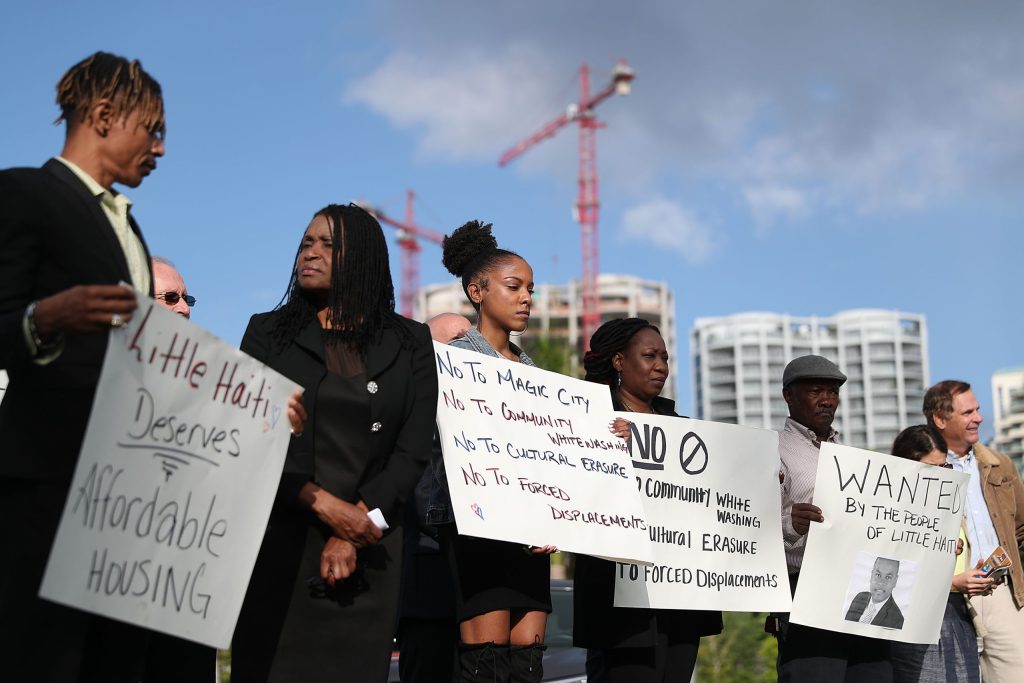
This is the second article from series about "climate gentrification." This series was supported by the Neil Pearce Foundation, a nonprofit organization dedicated to supporting journalism that seeks to make cities and their neighborhoods more livable for all people.
MIAMI - By the time Latonia Floyd stepped outside, a photographer's lens was already trained on her family's home.
«"No knock, no greeting," she said.
When she asked what he did, he replied that he "just took pictures of real estate" for his boss, a real estate investor.
The Floyd family had lived in this house for three generations, surviving the racial unrest of the 1960s, '80s, and 2020s, the crack cocaine epidemic, and everything that came with the nickname "ghetto." They had no intention of selling.
Soon after, her parents installed the fence she had long requested.
Neighbors used to pass through the courtyard on their way to church, children wandered freely from house to house without knocking, and Sunday dinners stretched across the porches and out into the street. Now, where people once walked freely, there stands a locked gate.
What seemed like rudeness that day was actually part of something bigger and has to do with climate change.
Miami currently leads the nation in cash home purchases, with investors stepping in uninvited to snap up long-owned Black homes. This is partly because rising sea levels threaten coastal properties, prompting developers and wealthier residents to rebrand long-neglected, predominantly Black neighborhoods like Floyd's as new, safer options.
Since 2023, half the houses on her street have been sold, including the pastel-mint-colored house next door. Three houses down, where rent was $800 per month in 2021, are now $2,200.
This process has a name: climate gentrification.
Miami's Black neighborhoods are located on a natural limestone ridge approximately 2.5 meters above the shoreline. As flooding worsens and concerns about sea level rise grow, wealthier residents living along the coast are moving to higher ground. This is displacing Black residents from their homes and forcing them to move to lower-lying, flood-prone areas.
In less than 15 years, the city's black population has declined from about 17% to 10%.
«"It's just incredible that [climate change] is part of the change we're seeing—gentrification," Floyd said.
The truth is, this could become a common occurrence across the country. Researchers estimate that by the end of the century, climate change will force more Americans to flee their homes than the Great Migration. In the greater Miami area, more than a million people could find themselves homeless.
For some, the future seems predetermined. But in Miami's African-American neighborhoods, residents are trying to show that this isn't necessarily the case. They want to turn their fight to preserve their neighborhoods into a lesson for other coastal communities.
Groups like Fight for Affordable and Sustainable Housing Miami, as well as long-standing organizations like Power U and the Right to the City Alliance, are creating community land trusts, fighting evictions, and pushing the city to incorporate equitable development principles into climate and housing plans. They want a climate-friendly future in which the neighborhoods Black Miamians fought for remain theirs and become more comfortable, safe, and accessible for everyone, not just those with the money to move to more upscale areas.
Nikki Floyd's Miami neighborhood is on the front lines of climate gentrification as real estate investors seek out high-elevation properties. (Adam Mahoney/Capital B)
Amid climate change concerns, Miami's Black families have become symbols of gentrification.
On the night Hurricane Andrew made landfall in August 1992, there was a belief it would destroy the city. In a sense, it did.
It was only the third tropical cyclone in history to reach the continental United States as a Category 5 cyclone. Fifty-four people died along the coast.
To the south, toward Biscayne Bay and Homestead, the landscape looked as if a bomb had gone off: entire neighborhoods had been reduced to concrete slabs.
Inland, in Overtown, the grid of streets and houses where Floyd grew up wandering with cousins and friends was battered—broken windows and downed power lines—but still intact. "Hurricane Andrew was a monster," she said. "But here, it was different than on the coast.".
The Federal Emergency Management Agency (FEMA) provided food, water, clothing, and temporary shelter to those affected by Hurricane Andrew in 1992. The storm displaced one million people and killed 54. (FEMA photos, Bob Epstein/Released)
Creating a safe environment in Black neighborhoods was not intentional, but it was not an accident either.
Long before anyone put the words "climate gentrification" together, Miami officials placed railroad and industrial sites inland, then added predominantly Black neighborhoods to them in the 1930s—and the associated pollution.
Floyd's father, John, calls his neighborhood the "dust bowl" because of the smog and dust that blankets the neighborhood, which is sandwiched between a cement plant and train tracks.
The location allowed the town to escape the impact of Hurricane Andrew, but it was considered so unattractive that Black residents were evicted there because of the presence of industry, says Terrance Cribbs-Laurent, a Black historian from Overtown. "We're on high ground to protect the railroad and industry, not ourselves.".
According to him, many of the city's Black neighborhoods are united by environmental racism. Further north, the Liberty City, Little River, and Little Hyatt Miami neighborhoods have grown as environmental and housing conditions have begun to push Black residents out of the overcrowded Overtown neighborhood.
These neighborhoods prospered for a time, but by the 1950s, white developers began buying up land from Black families, converting owner-occupied homes into rental housing, and gradually shifting the balance from ownership to rentals. In Overtown, highway construction in the late 1960s cut through its center, displacing thousands of people and shrinking the tax base, although Black residents continued to open churches, clubs, and small shops in the remaining neighborhoods.
A series of photographs from the Bob Simms Collection illustrates African American life in Miami from the 1950s to the 1980s. (Courtesy of the University of Miami Library)
These decisions constantly impact the present, whether a storm rages on the coast or an apartment building springs up on the edge of a playground. When Nicole Crook moved with her family to Overtown in 2011, she had no name for the process that made it difficult for her to live in Coconut Grove—the city's first all-black neighborhood, also located above sea level and the epicenter of black displacement many years earlier.
«"I didn't know it was due to climate change-induced gentrification," she said. "I just knew I could find housing here in Overtown that they considered affordable.".
A kayak on the streets of Miami in 2009 after several inches of rain, combined with high tides and a lack of drainage. (maxstrz on Flickr via Wikimedia Commons)
By then, developers and institutional investors had already begun snapping up land on the other side of the ridge. In recent years, billionaire Sarkis Izmirlian paid over $6 million for a declining storefront in Overtown, three Miami firms spent $16.5 million to acquire a site known as Block 19, and the $1 billion Magic City innovation district is taking shape in the neighboring Little Haiti neighborhood.
In the Overtown neighborhood, families are facing eviction notices and are forced to sell their homes under increasing pressure from tax collectors and wealthy investors.
On Floyd Street, property values have doubled in just two years, and with them, the economic demand for new homeowners has increased. Families who have lived here for decades pay only a few hundred dollars a year in property taxes, while newcomers pay nearly $10,000 to occupy a lot on higher ground.
She said the pressure to leave has become more aggressive in recent years, and its manifestations resemble racism more than market forces.
One Sunday last spring, Floyd's seven-year-old nephew, Brayden, ran into the house, yelling at her to "look at the wall." Outside, a mural depicting Black leaders had been defaced with a swastika, and the offensive N-word had been written next to it.
The graffiti, Crooks said, was a "message" about who the neighborhood was now for and who it wasn't. Black people "found a sense of safety and belonging in a hostile place," she said, "and now they're being told the land beneath them is too valuable for them to stay.".
Insurance is one of the main reasons for this influx of investment, attracting new people to predominantly Black neighborhoods. While Hurricane Andrew didn't devastate Miami instantly, it divided the city into areas the market deemed undesirable and areas it subsequently came to value.
After Hurricane Andrew, more than 63,000 homes along the Miami coast suffered severe damage. Within a year, 11 Florida insurance companies went bankrupt, and another 17, including State Farm and Allstate, cancelled policies for coastal customers or left the state entirely. Those companies that remained in the state tripled their reinsurance rates and revised their risk assessment models.
This was the first reboot.
Three decades later, a second reset has begun. Home insurance costs in Florida have nearly doubled since 2014, and along the Miami coast, premiums could quadruple by 2055—the highest of any U.S. city.
Sea levels along the Miami coast are projected to rise 30 centimeters by 2055. Flooding that once occurred once a century could now occur annually. As insurance costs soar, the search for cheaper and safer housing by wealthier individuals is partly a "market response" to this future. But local governments have, in a sense, also driven this shift.
A longtime restaurant in the Little Haiti neighborhood. (Adam Mahoney/Capital B)
Miami's climate plan, MiamiForever Climate Ready, explicitly calls for new "development along transportation corridors in areas less prone to flooding.".
Miami-Dade County acknowledged that its investments in climate projects in historically marginalized areas are increasing property values "without curbing the rising cost of living." At the same time, it is exploring ways to maintain coastal housing affordability to reduce the likelihood of residents leaving for inland areas.
The county's chief property appraiser, Thomas Regalado, is pushing to incorporate climate risks into tax assessments by reducing the value of some coastal properties susceptible to more frequent flooding and sea level rise.
«"We'll have to lower property values if that's what it takes," he said. His initiative could slow tax increases for some homeowners to make coastal living more attractive, but it could also cut the city's public budget.
The solution to climate change: helping people stay in their homes.
A dozen longtime Black residents sat around a gleaming conference table in a new high-rise building in Overtown, looking out through floor-to-ceiling windows at the neighborhood where they grew up. They had come for a community meeting to discuss the changes taking place in their neighborhoods. Not a single new resident from the building had shown up.
The complex's manager told Capital B that he estimates the "99%" tenants in the new building are not from the area.
Construction on new luxury high-rises is going on around the clock—drilling at 3 a.m., rattling loudly enough to wake up elderly residents—in a rush to attract new residents who "will never have to experience the culture of the place they're moving to," Crooks said before heading off to a residents' meeting.
Many of those already being evicted from Overtown and other predominantly Black neighborhoods are heading to areas devastated by Hurricane Andrew in 1992. Others are leaving Miami-Dade County altogether.
Between July 2023 and July 2024, Miami lost 67,000 people, the highest number of any county in the country at high flood risk. But these routes are only available to those with the money and mobility to make the choice.
In the Little Hayiti neighborhood, a three-bedroom home is renting for $2,800 per month or $33,600 per year. According to the federal government, the median annual household income in the area is $28,000. (Adam Mahoney/Capital B)
Today, more than 8 in 10 residents of Miami's African-American neighborhoods rent—twice the citywide rate—leaving most families at the mercy of rising rents and landlord decisions in America's most unaffordable city.
«"We're pushing people toward renting, when there should be greater responsibility for homeownership and inheritance," said Cribbs-Laurent. "Rents are rising, and you don't have the opportunity to save money or move to a larger home.".
Trenis Bryant, another activist, has already observed this in Liberty City. She helps lead the Miami Movement for Affordable and Sustainable Housing (SMASH).
The work began with a less-than-inviting atmosphere: residents gathered in cramped living rooms to discuss rent increases and mold issues, seniors pulled out stacks of building code violation notices, and parents exchanged advice on how to keep their electricity on. Initially, it was about "confronting unscrupulous landlords and participating in city hearings," she told Capital B. But now she's also doing something more radical: buying the land beneath the buildings and donating it to a public land trust to prevent outsiders from reselling it under the new climate model.
Jobs have already taken a hit. Since 2017, the average rent in her neighborhood has nearly tripled, and the Black population has nearly halved.
Displaced people are forced to live in overcrowded apartments with relatives. Others sleep in their cars or rent storage spaces between shifts.
«"We're talking about Black people going to work and still being homeless," Crook said. "Families sleeping in their cars with their children.".
Miami's African Americans are not alone. Nationwide, no racial or ethnic group has suffered more from gentrification than African Americans. Since 1980, half a million Black people have lived in gentrifying neighborhoods, while more than 3 million new Latino, Asian, and white residents have moved into these same areas.
Floyd noted that displacement, or "replacement," can begin small. Recently, a yoga studio opened a few blocks from the family's home in a space where neighbors used to pay bills and send money to relatives, attracting a new audience who perceive the neighborhood as a "discovery.".
«"You start meeting different people who don't care about this place," she said.
Trenis Bryant is a leader of the organization Fighting for Affordable and Sustainable Housing in Miami (SMASH). (Photo courtesy of SMASH)
When Bryant talks about climate gentrification, she begins by saying the air is weighing on people who haven't disappeared. She recalls summers when heat lingers for weeks on the pavement, neighbors faint at bus stops, and children can't sleep because their window air conditioners are broken. People "sleeping in the park" isn't a separate issue from "men offering cash for houses a few blocks away," she said.
The SMASH model begins with these individuals, aged 9 to 72. Residents spend hours making phone calls, knocking on doors, and interacting with other community members. In exchange, they are offered housing in a cooperative housing complex managed by the organization.
To date, the SMASH Land Trust has received approximately $1 million in funding from the Florida Community Loan Fund to acquire and rehabilitate multifamily properties, resulting in at least nine units of affordable housing.
However, finding capital for the most ambitious projects remains challenging. "If we had more resources to build more cooperative housing, we could get homeless people off the streets when temperatures reach 105 degrees in the summer and drop to 30 degrees in the winter," she said.
Under the SMASH community land trust model, a homeowner would receive a 51% stake in a home. For example, to purchase a $600,000 home, the homeowner would pay $306,000, with the remainder covered by impact investors. Given current average prices in Liberty City and the pace of investor speculation, acquiring even 50 homes would require tens of millions of dollars in capital.
It's a tiny island in an area where investors are buying up real estate by the block.
A former public housing complex in a historic, predominantly African-American neighborhood is being demolished to make way for a new mixed-income housing complex. (Adam Mahoney/Capital B)
Overtown holds the advantage
In March, a block from the desecrated mural, Floyd stood on the street with her neighbors. A tray of sea snail balls—a deep-fried delicacy common among African-Americans in Miami—was passed from hand to hand. The smell of seafood wafted through the air, even from this distance from the water.
«"Sink Man," Ken Mahoney, pulled out a folding table and a cooler stocked with soda and beer. Cars drove slowly past, music played, and neighbors called out to each other.
Everyone in the room also called her nephew, Brayden, "nephew." Here, she explained, everyone still considered each other as one of their own—"cousin, aunt, someone's relative.".
Ken Mahoney makes sea snail balls for his neighbors in Miami. (Adam Mahoney/Capital B)
The conversation remained casual for a while. Floyd joked and laughed with the shellfish vendor about his food, which he said was the best in Miami.
Then the situation changed. Someone mentioned a house a block away. "Sold quickly." For cash, they heard. The previous tenant moved out.
Earlier that day, Floyd had looked past houses she knew by heart and tried to imagine which one would be torn down next.
«"We're very lucky to be here," she said. "I think we'd be very lucky anywhere we were.".
But neither she nor her parents are ready to leave yet.
«"Where would we even go to live if he wasn't here?" Floyd said.
That same afternoon, she walked home with Braden, past the pastel mint-colored house and the newly painted murals, making sure the gate behind them was closed.
Read more:
-
From Watts to Washington: How 500 Black Neighborhoods Disappeared in 45 Years
-
The "Black Mecca" climate plan is causing Black residents to lose their homes.
-
As African Americans move south, they face the effects of climate change.
The article, titled "As sea levels rise and rents triple, Miami's Black neighborhoods are disappearing," first appeared on Capital B News.