








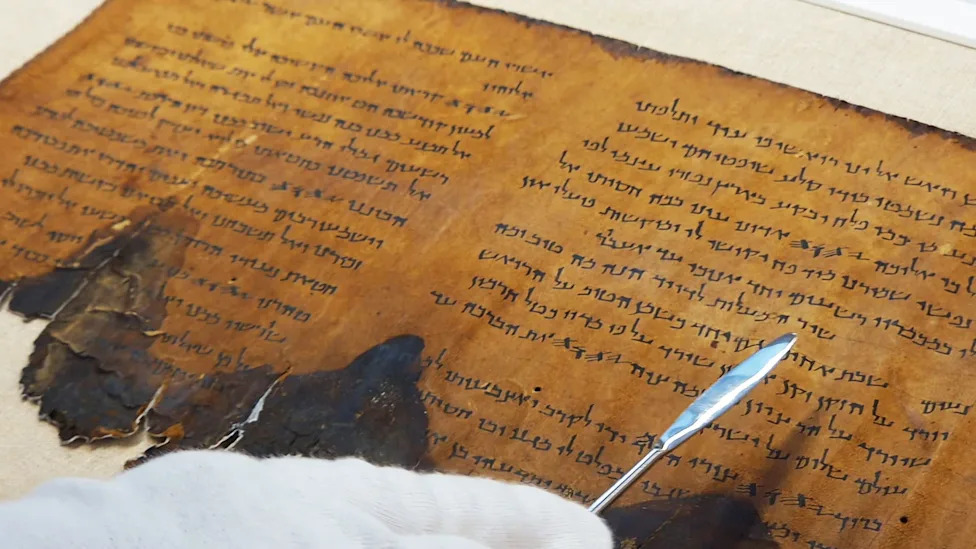
For decades, scholars have wondered whether the 364-day Qumran calendar was ever used in practice or whether it served only as a theoretical basis.
Researchers from Tel Aviv University (TAU) have proposed a solution to one of the historical mysteries associated with the Dead Sea Scrolls, namely the unique calendar of the Qumran sect.
For decades, scholars have questioned whether the 364-day Qumran calendar was ever used in practice. Some have suggested that the sect periodically added days or weeks to its calendar, while others have argued that the calendar was never used in the real world and served only as a theoretical basis.
However, a study recently published in the journal Tarbiz Quarterly for Jewish Studies , Tel Aviv University professor Eshbal Ratzon suggested that the Qumran calendar, consisting of 364 days, was indeed used by the sect in the early years of its existence.
Moreover, she argued that the calendar may even have been at the root of the conflict that led the sect to isolation in the desert.
The study noted that nearly 20 scrolls found at Qumran deal with calendars and astronomy, demonstrating the importance of the topic to the local community.
Ratzon explained that the Book of Jubilees, an apocryphal work that occupies a central place in the Qumran library, is fiercely critical of the existing lunar calendar, presenting a 364-day calendar as the original time scale received by Moses on Mount Sinai.
While Jewish life during the Second Temple period was centered on a lunisolar calendar, the Qumran calendar consisted of exactly 364 days: a number that is evenly divisible by seven, meaning that each year included 52 full weeks, and the holidays always fell on the same days of the week.
A symbol of rebellion against the dominant direction of ancient Judaism.
For the Qumran sect, the 364-day calendar reflected perfect divine order.
The calendar was also a symbol of rebellion against the political and religious leadership of Jerusalem, which determined important dates in Jewish life - a decision contrary to the beliefs of the sect.
They believed that the dates were set by God during the Creation of the world, and people should not and cannot interfere with this divine decision.
However, Ratson noted that the calendar was likely subsequently abandoned for two reasons.
Firstly, the calendar deviated by one day and a quarter from the 365-day astronomical year, and this difference quickly accumulated and soon led to the transfer of holidays, as Ratson claimed.
For example, if the Qumran calendar had been used for 20 years, the holidays would have shifted by almost four weeks relative to the seasons. After several decades, the residents of Qumran would have celebrated the spring festival in winter or autumn.
For a community that viewed festivals as agricultural celebrations associated with harvests, first fruits, and the changing of the seasons, such a shift presented a clear fundamental problem.
The study explained that while the calendar initially served as a perfect framework from a conceptual and mathematical standpoint, over time it became increasingly disconnected from the natural cycles it sought to control.
Improving relations with the Hasmonean leadership
The second reason for the abandonment of the calendar, according to Ratzon, was the warming of the sect's relations with the Hasmonean leadership under the second king, Alexander Jannaeus (103–76 BCE), who supported a halakha similar to their own and opposed the Pharisaic leadership.
This move allowed Qumran to adopt a more "practical" calendar similar to that used in the Second Temple, while retaining the 364-day calendar as a theoretical concept that was valid at the time of Creation and could potentially be used again at the "end of the world.".
«"The Qumran calendar has long been considered one of the defining characteristics of the Qumran sect, as well as one of the most enigmatic mysteries of the Dead Sea Scrolls," Ratzon concluded. "This study offers an alternative to the apparent contradiction between the functional and theoretical calendars.".
«"It's entirely possible that the calendar was indeed used for a period of time, but then, having lost its practical role due to both its inherent problems and political changes, it became a religious ideal and a symbol of identity. This explains both its central place in the Qumran scrolls and its gradual disappearance from historical reality.".