








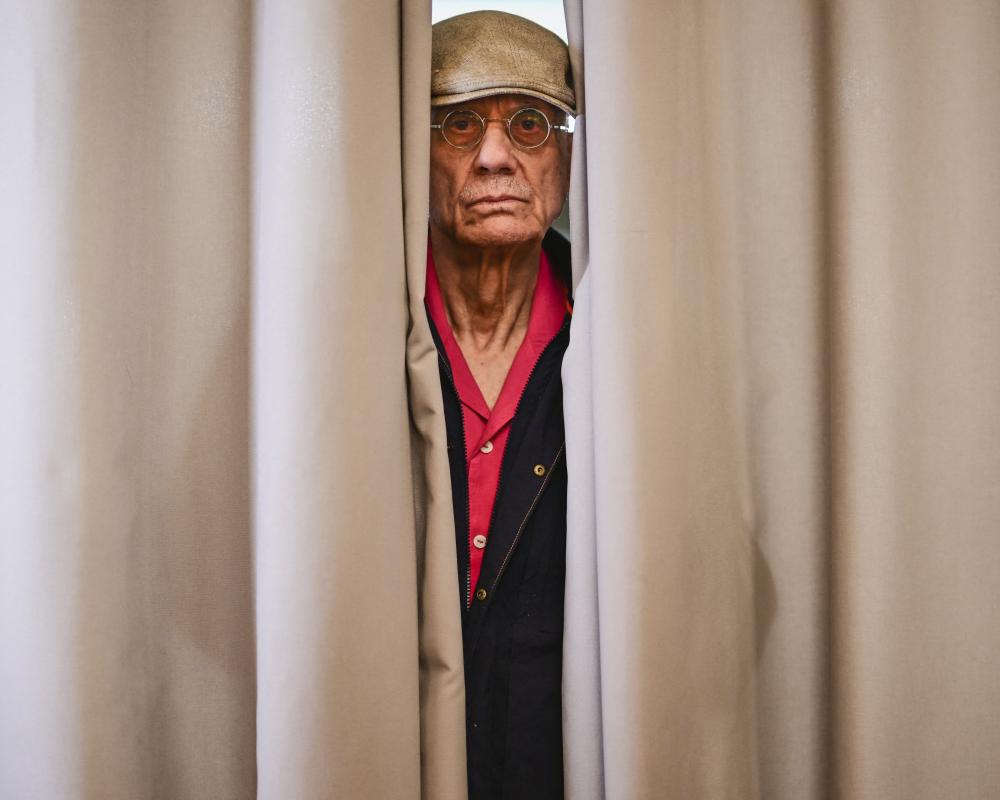
James Elroy doesn't own a computer, his press secretary explains, so a phone interview would be acceptable. When the self-proclaimed "mad dog of American crime fiction" picks up the landline at the appointed time, it turns out he's never owned a cell phone. He's also never sent an email. And he can't even figure out how to turn on his ex-wife Helen Noad's television.
See also: "They're trying to narrow the horizons of young people": How the number of book bans is growing in the US
«"It's all very complicated, and to me, it's about people's satanic addiction to computers," Elroy, 78, says cheerfully in his deep baritone from his apartment in Denver, Colorado. "I don't participate in internet chat rooms, and I realize the internet is full of crazy nonsense and people with the most ridiculous beliefs on earth.".
When his agent or publisher wants to contact him, Helen, who lives in a separate apartment, prints out an email, hands it to Elroy, and the author of LA Confidential and The Black Dahlia dictates a response. "I have a whole drawer full of printed emails," he says.
For his 18th novel, "Red Leaf," published June 9, Ellroy has a system whereby his handwritten pages are given to a retired FBI agent couple in the south of France, who magically send back typed pages. In the absence of Google, he has a researcher "read the books, write summaries, and send me the pages.".
The novel "Red Leaf" appears to be quite research-intensive. Continuing the plot of Ellroy's previous book, "The Magicians," the action takes place in October 1962, after the Cuban Missile Crisis. Then-Attorney General Robert F. Kennedy, fearing a domestic backlash from communists, orders the overzealous Los Angeles Police Department to launch a "red investigation.".
Once again, Elroy's Los Angeles is cast in a noir-like world of sleaze and villainy. He weaves a vast tapestry that includes Richard Nixon's failed gubernatorial campaign, the campaign of future Los Angeles mayor Tom Bradley, the Rumford Fair Housing Act, the horrific "Red Ripper" murder spree, and a corrupt labor union acting as the Communist Party's law enforcement arm.
Ellroy calls this approach "reckless verisimilitude," combining objective historical events with subjective fantasies to uncover deeper truths about the time and place. His website describes Red Leaf as an "anti-communist novel" that "unquestioningly follows the tarnished tradition of Ayn Rand and Mickey Spillane" and challenges readers to "willfully reject" it.
Ellroy, always known for his rebellious streak, his knack for challenging conventional wisdom and destroying liberal "sacred cows," set out to overthrow the "Hollywood Ten"—a group of directors, producers, and screenwriters, including Dalton Trumbo, who were subpoenaed by the House Un-American Activities Committee (HUAC) in 1947 and refused to testify about possible communist ties. Their refusal to cooperate led to the creation of Hollywood's first systematic "blacklist" by studios.
The viciousness of Joseph McCarthy's "witch hunt" is now part of the foundational narrative Hollywood tells about itself in films like "Good Night, Good Luck" and "Trumbo." Ellroy disagrees. "I came to clarify the Red Scare. My curiosity and my political activism are all retrospective phenomena, going back to my teens or earlier, or to a time before I became an adult.".
According to Ellroy, the Hollywood figures who refused to name names knew the consequences of their silence. "This was the biggest criminal conspiracy of the time, and they should have named names," he says. His satirical take on this "pretended martyrdom" culminates in an absurdist scene early in the book, where communists and right-wingers join hands and sing "We Shall Overcome.".
In contrast, Nixon, widely regarded as the ultimate villain, is regarded with a tenderness bordering on affection. Ellroy was 20 years old when he watched him win the 1968 presidential election. "I remember thinking, 'This guy is just like me.' And by that I mean I lose my temper, I constantly need to shave, my clothes don't fit, and you know what else? I'll burn your ass to the ground with my inexorable will.".
The author adds: "In 1962, he was just one guy; he hadn't gone down the drain yet. He went down the drain, hard, and got what he deserved, and at least he had the decency and honesty to resign and not drag the country into even more trouble than he already had.".
The protagonist of Red Leaf is Freddy Otash, Elroy's recurring antihero. The real Otash was a notorious corrupt private detective and extortionist whom Elroy met and paid $10,000 for consulting on his most famous book, American Tabloid. He says, "I flew to Miami to meet him, and he was an elderly man, an absolutely disgusting man, a con man, a liar, and certainly one of the best liars in the world, and not in the best shape." ».
Knowing that Otash would inevitably betray their agreement, Elroy excluded him from the book, replacing him with a fictional character. But when Otash died of a heart attack the following year, he became Elroy's main literary toy.
«"I made him much more tortured, more religious, more attractive to women, with more of a human essence bubbling inside that wants to come out, and you see that in 'Red Sheet,' when he becomes, oddly enough, an accomplice to the civil rights movement and the passing of the Rumford Fair Housing Act.".
In the novel "The Red Sheet," Otaş falls in love with a real historical figure: folk singer Judy Henske. She was Elroy's "fantasy girlfriend in 1962 and 1963," despite being 12 years his senior.
«"My father measured my height every few months because it seemed like I was going to be a tall kid. Judy Henske was 6'1", and I remember that day in the fall of 1963 when I was an inch taller than her, and it dawned on me: she was going to be my girlfriend. Besides the fact that I was a dumb 14-year-old and she was 26, there were other issues.".
He never met Henske, who died in 2022, but he tracked down her widower to pay him to include her photograph in a new book. "I found him, and we talk on the phone occasionally. She was also older than him. He's 81 now, and Judy would have been 90.".
Stories like these suggest a soft heart beneath the stern exterior of Ellroy. Born in Los Angeles in 1948 to an accountant and a nurse whose unhappy marriage ended in 1954, he previously described his life this way: "Boy's mother is murdered. Boy's life is ruined. Boy grows up a homeless alcoholic, imprisoned. Prisoner sobers up and writes, finding salvation. Prisoner becomes the Mad Dog of American crime fiction.".
In 1958, when Elroy was 10 years old, his mother, Geneva Hilliker, was murdered. Her body was found lying in a thicket of ivy, with a nylon stocking and a cotton cord around her neck. In his memoir, My Dark Places, published in 1996, Elroy wrote: "Her face was slightly blue. She looked like a typical victim of a nighttime abandonment.".
The memoir is an investigation into his mother's unsolved murder, but Elroy rejects the armchair psychological theories that suggest the tragedy shaped his literary style. "It influenced my worldview; I became very interested in crime, watched crime TV shows, went to crime movies, and, above all, read crime novels, starting with children's books and then moving on to adult novels, which is what I still read.".
Raised on Hardy Boys detectives and "the garishly anti-communist novels of Mickey Spillane," he mastered the mechanics of storytelling on his own. "All my writing talent came from the fact that I was just a nerd who loved to read. I learned style. I learned where to put paragraphs. That's the only education I ever had. I didn't finish high school. I didn't go to college." ».
As a child, Ellroy lived on the streets, sleeping in parks or abandoned apartments he broke into, and also spent a brief but chaotic stint in the Los Angeles County Jail for various minor offenses—driving under the influence, disturbing the peace, and petty theft. While in prison, he battled pneumonia and a lung abscess and read tattered paperbacks carried around by a library volunteer.
However, he dismisses any suggestion that his time behind bars gave him a true understanding of the criminal underworld. Instead, he found the six-person cells overcrowded and full. « "ridiculous, ridiculous, false, tall tales about committing daring crimes and having sex with the most seductive women in the world, including all the top movie stars of the time, and everyone just sat there and lied.".
Ellroy is known for creating his own reputation. In 2006, when asked by the New York Times whether he considered himself a novelist or a detective writer, he said, "I am a master of fiction. I am also the greatest detective writer of all time. I am to the detective novel in particular what Tolstoy was to the Russian novel and Beethoven was to music.".
Is this a sincere belief or a game, a subsidiary element in the creation of a literary image? Ellory replies: «A more realistic and accurate way to put it is this: [Samuel] Dashiell Hammett, whose first novel, Red Harvest, was published in 1929—97 years ago—and I represent the alpha and omega of the American hardboiled novel. I think I descended from him. He died when I was 12; of course, I never knew him.«.
He muses, "I'm more of a Hammettian than a Chandler. I think [Raymond] Chandler is complete nonsense, his plots don't hold together and are riddled with unworkable similes, even though they're set in Los Angeles, and I'm from Los Angeles and obsessed with the city. I think Los Angeles was just a happy accident for me. Geography is destiny. I was born in Los Angeles, the epicenter of film noir in 1948, at the height of the noir era." ».
His disdain for Chandler is comparable only to his disdain for the Oscar-winning 1997 film adaptation of his novel L.A. Confidential, starring Russell Crowe, Guy Pearce, Kevin Spacey, and James Cromwell. For many years, while director Curtis Hanson was alive, Ellroy refrained from publicly criticizing the film. Now, however, he's not shy about his words.
«"The film is as deep as a tortilla," he says. "In late 1997, the late, highly respected novelist and screenwriter William Goldman took it apart and explained in detail why it makes no sense and is so devoid of a coherent narrative arc that Guy Pearce has to explain everything that's happened in the last two and a quarter hours in a dialogue scene that lasts at least three or four minutes.".
«"I'm going to introduce it while I'm in Los Angeles, and I'll say that it shouldn't have premiered at Grauman's Chinese Theatre. Considering it's a film about schizophrenia, it should have premiered on a psychiatrist's couch in Beverly Hills, to show both sides of his psychopathy. It's trying to be a crowd-pleaser and a thrilling crime drama at the same time, but it fails at both. It's a complete failure.".
Even writers run out of time. Earlier this year, 80-year-old Julian Barnes announced the writing of his final novel, declaring, "I've played all my tunes," while 92-year-old Michael Frayn declared on BBC Radio 4, "Sadly, it's all over. Writing was my life.".
Elroy admits, «Time is ticking. In a year and ten months I’ll be 80, and that won’t last forever. I want to write many more books, and I’m writing a new one now. I don’t want to stop. I don’t want to say goodbye to Helen anytime soon, and as the poet and priest Gerard Manley Hopkins said, «Man is born to suffer, / It’s Margaret you mourn.» I’m perfectly healthy, but I still look the other way.».
His Christian faith brings him solace. Does it also influence his view of human nature? Given his literary preoccupation with the worst aspects of our nature, does he believe we are all born sinners? "There are many kinds of sin, many degrees of sin, and—this is an archery term—it means missing the mark, and all men do that.".
«"Thank God that people like rapists and burglars are a tiny minority. I enjoy seeing people. I get some strange pleasure from interacting with so many people and from our diverse population." » .
This leads to a couple of final stories. «I don’t drive anymore. I’m very clumsy; I always have been. About forty years ago, a doctor asked me, „Have you always been this clumsy?“ I said, „Yes, I’ve always been clumsy.“ He said, „Wait until you get old. Then you’ll become even more clumsy.“ And he was right.».
«"I have an Ethiopian taxi driver who takes me on errands, like to church or the grocery store. We're very friendly, we discuss American and African follies, and he said something incredibly funny about Trump. He said that Donald Trump is America's Joseph Mobutu," referring to the former dictator of Zaire, now the Democratic Republic of the Congo. "We had a good laugh about that.".
-
The Red Sheet album will be released on June 9th.