








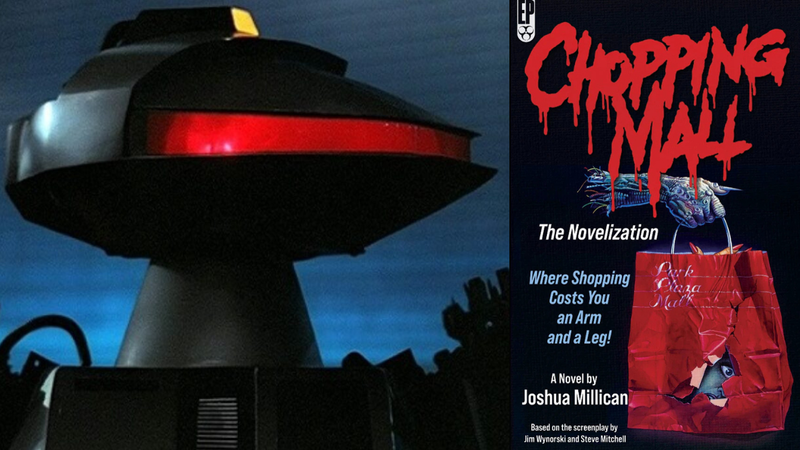
Let's get one thing straight right away: no, in the novelization of the film «"Shopping mall"» There's no way to recreate what was depicted on the poster. As dedicated fans know, the film was originally released under the title «"Killer Boatmen »" and contained an image of one of the security robots killing people - completely honest.
Unfortunately, this version flopped, and so, after several cuts to make the film even shorter and a title change, it was re-released in hopes that this time it would find its audience. But this also meant a new poster, and thus the familiar image of a robotic arm clutching a bag of body parts was born.
The only problem: there's no dismemberment in the film! (Unless you count the girl whose head is completely blown off, of course.) The robots do some serious damage, but it's all pretty straightforward: electric shocks, stab wounds, and laser fire are their modus operandi. More than once, I've heard someone say they're disappointed by the lack of actual chopping in the film, which is incredible, because what's in there is pretty funny, too.
Chopping Mall (Photo: Lionsgate)
However, Joshua Millican's novelization finds a few moments that deviate from the final film and give fans a little more food for thought. I suppose he needed to, as the film is only 72 minutes long with credits, so even with his additions, it's still the shortest book I've reviewed in this column (150 pages). I don't want this to be taken as a complaint, but I must emphasize that it was actually quite enjoyable to read this book in two sittings.
More detailed information can be found in the article «"Shopping mall and the dangers of artificial intelligence.".
Millikan offers four key additions that will catch the eye of even a casual fan of the film, and the first is immediately noticeable. Although the film opens with a commercial featuring robots attacking a jewelry thief in a shopping mall, the author offers a different prologue. Here, we meet the scientists and military personnel who develop these machines and dream of larger-scale missions than protecting shopping malls (i.e., participating in actual combat).
In retrospect, it seems like an odd addition, since we never see these characters again (including one named after Barbara Crampton, who plays Susie in the film) and something even more ridiculous happens in a later scene, but at least it immediately makes it clear that this won't simply be a beefed-up version of the finished film.
The author also adds a couple of extra action scenes to increase the overall body count. In the first of these, the characters Paul and Mary Bland (played by Paul Bartel and Mary Woronov, reprising their roles from film "Eating Raoul"« ) return to the mall with the horse, intending to use its meat for their restaurant the next day. Unfortunately, they encounter one of the robots, which instantly vaporizes all three with its laser fire.
Raoul at Chopping Mall (Photo: Lionsgate)
The second part is the culmination of a strange new storyline about the "Mall Mole." Throughout the story, characters refer to and reflect on the urban legend of a human-sized mole roaming the back hallways of a three-story shopping mall. It's a strange tale that finally finds its conclusion with the introduction of Jamal, a character mentioned but not seen in the film.
It turns out Jamal was hiding from drug dealers and accidentally discovered a secret section of the hallway, which he managed to transform into a makeshift studio apartment. He's been living there for years now and—thanks to a large fur coat stolen from a store—is the very "Mall Mole" people claimed to have seen. He survives an encounter with one of the robots, but then, at the end, encounters a fourth robot, a fun surprise for fans (who know there are actually only three in the film).
This small addition leads smoothly into the fourth and strangest major addition: aliens! Playing off the trope that the best sci-fi stories involve robots *or* aliens, we're treated to a brief epilogue in which the observing intergalactic beings claim responsibility for the malfunction that sent the robots spinning out of control. Then, having had their fun, they fly off to wreak havoc elsewhere. It's a bizarre sequence that, frankly, doesn't seem all that far-fetched; perhaps something dreamed up by producer Roger Corman and/or director Jim Wynorski, given their penchant for such absurdities.
The remaining changes are minor. The robot's demonstration has become a bit more varied: one character even asks a question about Asimov's Laws of Robotics, and new scenes with previously unseen military sponsors have appeared. Millikan generously weaves references to 80s hits into the dialogue and internal monologue, including a reference to the film "« Fast Times at Ridgemont High, addressed to Alison, played by Kelly Mulroney, a colleague Milroney on the TV series .
I also found it amusing that he attributes Susie's panic over the air ducts to claustrophobia, because she's thinking about what caused her condition: being trapped inside an old refrigerator. Any '80s kid worth their salt will instantly recognize this story from a memorable (and terrifying) episode. «Punky Brewster» , and I couldn't help but wonder if any of the other little biographical details about the characters were also inspired by other 80s shows or movies that I just didn't notice (I didn't watch EVERYTHING!).
Otherwise, it sticks to the film's plot, which is quite logical: the main attraction «Shopping center» The film's charm lies in its simplicity and humor, so complicating it with secondary plotlines and drawn-out dialogue would be a mistake. And that gave me a good reason to revisit this 40-year-old film, adding a little extra value.
It's available as an e-book on Kindle for just six dollars, but there are also paperback and mass-market versions available for those (like me) who like their books to be displayed proudly on the shelf. Plus, it's a movie about a shopping mall—buying a paperback seems more appropriate, right?