








It is difficult to imagine two more similar, yet different, worlds than Earth and Venus.
Our own world is lush, wet and vibrant, teeming with life and geological activity.
Venus, on the contrary, is like an evil twin.
It shares features with Earth—both worlds are roughly the same size, density, and mineral composition—but it has no liquid water on the surface, ambient temperatures hot enough to melt lead, crushing atmospheric pressure, and suffocating clouds of carbon dioxide that rain sulfuric acid.
Scientists have long wondered whether Venus has always been so hostile.
While some models suggest that our neighboring planet may have once been covered in oceans, others argue that the water disappeared so early that no trace of it should remain today.
In a new study published in the journal Earth & Planetary Science Letters, It is claimed that geological traces of those long-vanished seas may still remain on the surface of Venus.
«"While the interpretation of these features is controversial," writes a team of researchers led by geologist Richard Gale of the University of London in the UK, "there is compelling evidence that Venus once supported oceans, and possibly life, over much of its surface.".
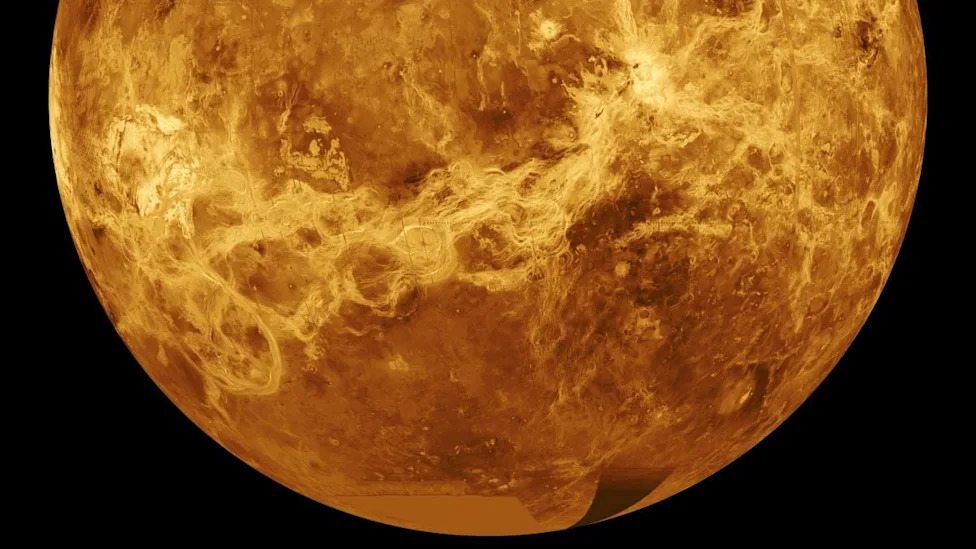
Venus as photographed by NASA's Mariner 10 spacecraft in 1974. (NASA)
The surface of Venus is difficult to see through the dense cloud cover. Most of the data available today comes from NASA's Magellan probe, which used radar to map the surface of Venus from orbit for several years in the early 1990s.
These images revealed a rugged landscape shaped by volcanic activity – that Venus is a volcanic world is beyond doubt, as more than 85,000 volcanic features have been discovered to date.
Gail and his colleagues wondered whether some of these supposedly volcanic features were actually marine in origin.
If so, the oceans they left behind would have been vast. Researchers suggest that water may have once covered approximately 90 percent of Venus's surface, representing approximately 40 percent of the water in Earth's oceans.
They argue that three types of geological features fit more logically into the context of the vanished seas.
The first category is vast territories crossed by giant polygonal patterns.
Some polygons on the surface of Venus, not all of which are easily explained by volcanic processes. (Gale et al., Earth Planet. Sci. Lett. , 2026)
Previous studies suggested that these cracks were formed by the cooling and compression of volcanic rocks.
Gail and his colleagues argue that they more closely resemble the polygonal fault systems found in clay-rich marine sediments on Earth.
These crack networks form as thick layers of seafloor silt are buried and compacted, squeezing out water like a sponge. As the sediment compresses and settles, they can form polygonal patterns extending for kilometers.
The second clue lies in the huge canals known as channels .
For decades, they were commonly interpreted as lava channels. But this explanation is not without its problems. Some of the channels extend for thousands of kilometers, which many researchers believe is much further than lava could realistically flow.
Researchers suggest that many of these channels, instead, resemble underwater channels on Earth, formed by dense currents flowing beneath the ocean's surface.
They note that almost a third of polygonal landscapes are associated with channels , which appear to emerge from plains with no obvious volcanic source before terminating in deeper basins – as would be expected from submarine channels.
The characteristics are consistent with pathways for the formation of marine sediments. (Gale et al., Earth Planet. Sci. Lett. , 2026)
Finally, the third clue lies in the wrinkled ridges that form a pattern on the lowlands of Venus.
According to the researchers, these ridges may lie on top of thick layers of salt left behind by the evaporation of ancient oceans.
They note that Earth's Mediterranean Sea deposited vast layers of salt when it largely dried out during the Messinian Salinity Crisis about 5.5 million years ago. They estimate that Venus could have deposited a salt layer at least 64 meters (210 feet) thick—possibly even more—which would have been enough to deform the overlying crust.
It's an intriguing hypothesis, but one that will likely remain controversial until new spacecraft arrive to explore Venus, which has been somewhat neglected in space exploration programs of late.
However, ESA's upcoming EnVision mission and NASA's VERITAS orbiter, which are expected to map Venus in much greater detail than Magellan, could help verify whether these features do indeed preserve evidence of ancient oceans.
See also: Giant concentric rings discovered in Venus' atmosphere
None of the three lines of evidence is definitive. Each could, in principle, be explained by volcanic activity, tectonic processes, or other aspects of Venus's geological history.
However, the researchers say that taken together, the data paints a compelling picture of a world that once had oceans before it succumbed to a runaway greenhouse effect less than a billion years ago.
«"By that time, life was already well established on Earth; the possibility that a runaway greenhouse could have wiped it out on Venus has serious implications for our own future and for life beyond the Solar System," the researchers write.
The article was published in the journal Earth & Planetary Science Letters .
This article was fact-checked and edited by Fiona McDonald. While we pride ourselves on our process, we're only human. If you spot an error, please let us know.
ScienceAlert articles are written, fact-checked, and edited by humans; they are never generated by artificial intelligence. Don't miss a single article; subscribe here.
Related news
-
The Sun contains more silver than previously thought.
-
The JWST telescope may have detected heavy water on an alien planet.
-
The JWST telescope just examined two stars suspected of hosting Dyson spheres. Here's what it found...