








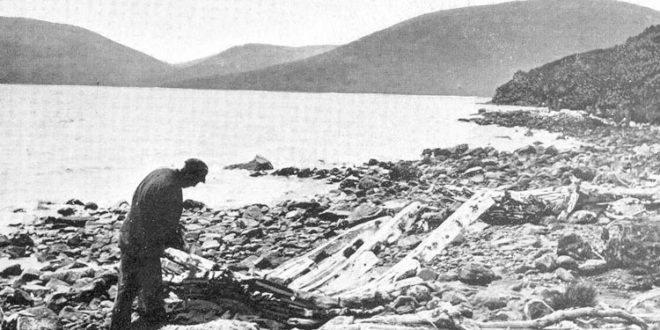
The Auckland Islands, located 465 km from New Zealand, are home to numerous shipwrecks and stories of castaways. Among them, the most famous is the story of the castaways on board «Grafton» . When the ship «Grafton» was wrecked, its crew of five endured the island's harsh weather for over a year. At a time when most shipwrecks ended in death, the crew's survival «Grafton» attributed to the leadership qualities of the ship's captain, Thomas Musgrave. Read on to learn more about the castaways on board. «Grafton» , a crew that spent 18 months on a subantarctic island and survived.
Ship "« Grafton"» A 56-ton vessel was hired in the 1860s to sail to the Campbell Islands. The five-man crew was tasked with surveying the islands for tin and hunting seals for their skins and oil.« Grafton"» sailed on November 12, 1863.

« Grafton"» — a small schooner chartered by Sydney merchants Charles Sapri and his partner, Musgrave. They needed a ship to sail to Campbell Island in search of a tin mine. They approached Sapri's friend and retired French captain, François Raynal, with an offer to command the vessel. Raynal accepted, but declined the captain's position. As a result, at Musgrave's suggestion, the captain «Grafton» became his nephew Thomas Musgrave.
Captain Thomas Musgrave was a 30-year-old American of British descent. Raynal was a 33-year-old Frenchman. Three more crew members were recruited: George Harris (20), Alexander Maclaren (28), and Henry Forges (28). With this crew of five «Grafton» began his ambitious journey on November 12, 1863.
Vessel «Grafton» The ship arrived at Campbell Island on December 2. The crew spent about a month searching the island for traces of tin, but were unable to find any. The island's seal population was also limited. Meanwhile, one of the crew members, Raynal, became seriously ill. Therefore, the crew decided to head for the Auckland Islands.

The ship "Grafton"« The ship left Sydney on November 12, 1863, and after a difficult journey, anchored off Campbell Island at 11 a.m. on December 2. In the following days, Musgrave and Raynal searched for a site for a tin mine, but their search proved futile. Raynal soon fell gravely ill and miraculously escaped death.

Musgrave continued searching for tin, while the others began seal hunting. Before departure, the crew was told that there would be a large number of seals on Campbell Island, but they caught very few seals there, as there were only a small, limited number. After unsuccessfully searching for a tin mine and due to the low seal population, the crew decided to abandon the entire venture. They decided to return to Sydney and visit the Auckland Islands en route in the hopes of hunting seals. December 29, 1863 «Grafton» set sail again, heading for the Auckland Islands.
December 31, 1863 «Grafton» The ship reached one of the bays of the Auckland Islands, but a storm on January 1st and 2nd sank the vessel. Fortunately, the crew managed to reach shore safely and salvage some of the navigation equipment, tools, provisions, and other supplies.
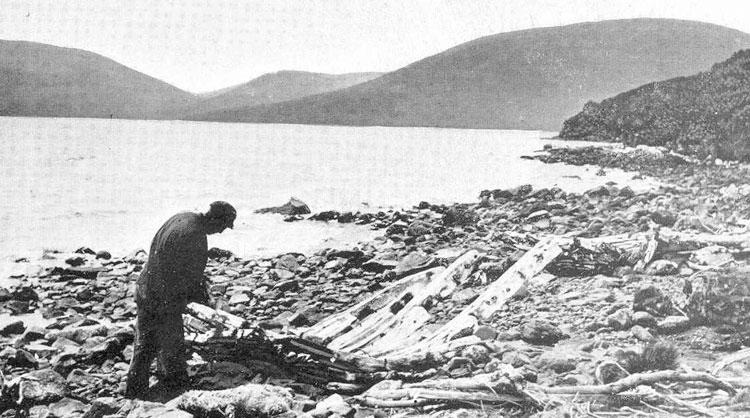
After two days at sea, the crew« Grafton"» On December 31, 1863, the Auckland Islands were sighted. The ship entered Carnley Harbor on January 1, 1864, at 3:00 PM. The weather soon changed, and a severe storm arose. Due to the storm, the captain was unable to find an anchorage. The next day, the ship entered the northern part of the harbor, and Captain Musgrave decided to set two anchors. The chain of one anchor broke, and the other anchor began to drift. At 10:00 PM, a strong wind blew, and by midnight on January 3, the ship had drifted onto the rocky shore and was damaged beyond repair.
By the morning of January 3, the crew managed to reach land. The men were relieved to discover that the resources on board had not been significantly damaged. The crew was able to retrieve their personal belongings, provisions, and tools from the ship.
As a temporary shelter, the crew constructed a tent from materials salvaged from the sunken ship. They later built a hut out of wood and stone, naming it "Epiguite." They subsisted on birds, fish, seal meat, and water, supplementing the food supplies salvaged from the ship. They even managed to brew beer from rhizomes growing on the island.
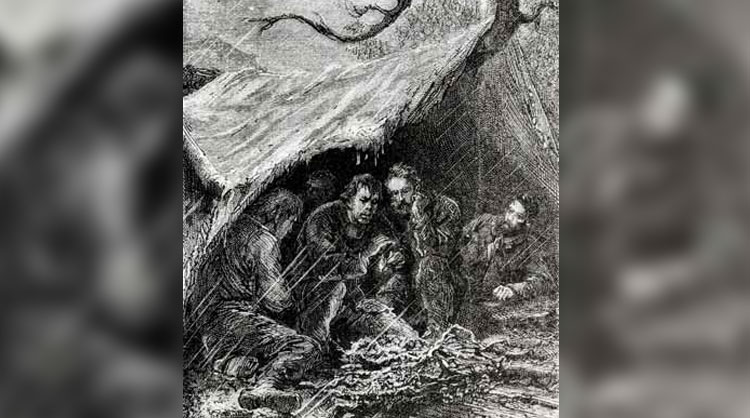
After the shipwreck, the crew constructed small tents from sails. This provided them with temporary shelter from the elements. A few days later, they cleared a clearing in the coastal forest and erected a large tent. The men took wood, rope, iron parts, and tarpaulin from the ship. Of all the sailors, Raynal had the most experience in hut building. He supervised them in the construction of the hut, using an axe, hammer, adze, and drill. They succeeded in constructing the hut from ship's timbers and wood cut in the forest. The hut contained a stone chimney, a dining table, and a desk. At Musgrave's suggestion, the hut was named "Epigwaite," meaning "house by the waves.".
The shipwrecked men managed to salvage food, but the supplies would only last for two months. So the men began looking for other options. Their diet consisted primarily of seal meat, as the island was home to numerous sea lions. They also included birds, fish, and mussels. Reynal even managed to brew a kind of beer from the abundant rhizomes. Stilbocarpa polaris . He brewed and fermented them, turning them into beer. The beer helped the men prevent scurvy.
On the island, the men sewed clothes from sealskin. For entertainment, Captain Musgrave began taking reading classes. Reynal made a chess set, dominoes, and a deck of cards. He later destroyed the cards after learning that Musgrave didn't take defeat well.
While awaiting rescue on the island, the crew fashioned a boat from the wreckage. Using this boat, three of the crew, including Captain Musgrave, made a daring journey on July 19, 1865, reaching Fort Adventure on Stewart Island on July 24. From there, they sailed to Invercargill and raised funds to return to the Auckland Islands to rescue the remaining crew members.

The team initially hoped that their business partners would send a ship to investigate what happened to the« Grafton"» . But after spending a year on the island and not seeing a single ship, they decided to find their own way off the island. Using wood, sealskin, and metal from the sunken ship, Raynal crafted a pair of bellows. The bellows were used to forge tools from the metals salvaged from the sunken vessel. Using these tools, they modified the ship's hull, increasing its length and height. The finished boat measured 17 feet long and 16 feet wide and was named "« Salvation ».
The boat was then tested, but it proved insufficient to accommodate all five men. So Captain Musgrave left two men, Harris and Forges, on the island. On July 19, Musgrave, Raynal, and McLaren set sail for Stewart Island. At first, they had a favorable wind. However, it soon gave way to a storm. The boat continued sailing in bad weather for five days, and finally, on July 23, the men sighted Stewart Island. Lifeboat entered Port Adventure on 24 July 1865.
At the port, the three men were met by Captain Cross, who provided them with a wash, clean clothes, food, and a place to sleep. All three were extremely exhausted and had slept for 24 hours. Upon awakening, they found themselves aboard Captain Cross's cutter.« Flying Scud"» , heading to Invercargill. In Invercargill, the funds needed for the rescue operation were raised through a public subscription.
Captain Musgrave returned to the Auckland Islands by ship «Flying Scud» and rescued Harris and Forges. They reached Invercargill, where they reunited with the crew. From there, McLaren, Raynal, and Forges returned to Melbourne. Musgrave returned to the Auckland Islands on an official search operation, while Harris remained in New Zealand.

With the money raised for the rescue operation, Captain Musgrave set sail on the« Flying Scade» from Invercargill. Upon reaching the Auckland Islands, Musgrave rescued the two remaining crew members. After seven weeks of bad weather and a faulty compass,« Flying Scud"» arrived in Invercargill. Along with Harris and Forges, Captain Musgrave brought Raynal's furs for him. Having reunited the crew, Thomas Musgrave immediately returned to the Auckland Islands to assist in the official search for other castaways. From there, he returned to Sydney and submitted an official report.
From Invercargill, three crew members - McLaren, Raynal and Forges - set off for Melbourne on the schooner «Swordfish» . George Harris remained in New Zealand, where he headed to the gold fields.
Captain Musgrave and Raynal later wrote books about their experiences on the ship. Raynal's boots, made from tanned sealskin, his bellows, and his albatross bone needle, have survived to this day and are housed in the Melbourne Museum.
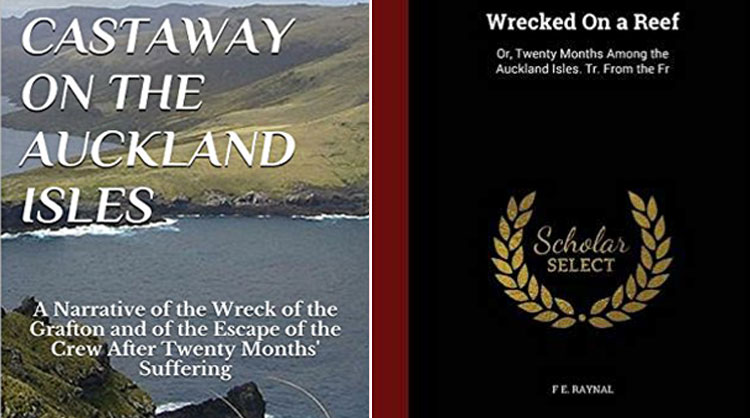
The captain of the ship «Grafton» , Thomas Musgrave kept a journal during his time on the Auckland Islands as a shipwrecked survivor. At first, he wrote in it with ink. But when the ink ran out, he began using seal blood. Musgrave later wrote a book called "« Shipwrecked in the Auckland Islands »", which was published in 1865. The book contains a map of the islands.
Second Mate «Grafton» , François Raynal, also wrote the book "« Lost on the Reef"» , describing the shipwreck and subsequent events. It was first published in 1869 in a French travel magazine. Later, in 1870, it was published in a much longer form under the title «The Lost Islands of Auckland . In 1874, its English translation was published.
[sources: 1,2,3,4,5]