








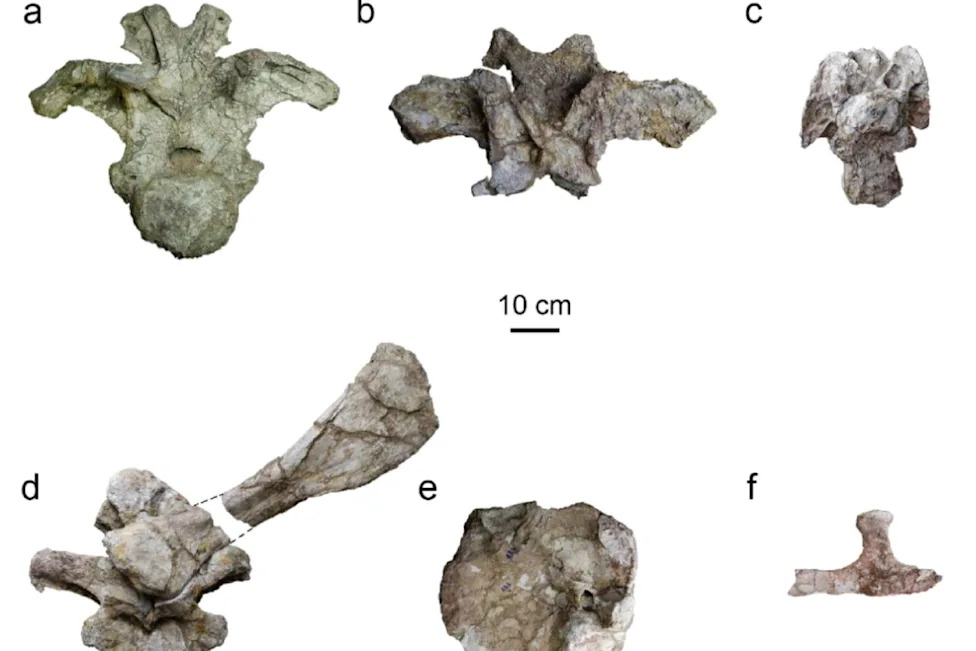
A single dinosaur vertebra discovered in Thailand has allowed scientists to identify a new species of giant, long-necked dinosaur, demonstrating how even a single fossil fragment can advance researchers' knowledge of prehistoric life.
The new species, Uragasaurus kalasinensis, lived about 143 million years ago in the wooded areas of Southeast Asia, shortly before the transition from the Jurassic to the Cretaceous period.
What's happened?
Scientists discovered the fossil in the Phu Kradung Formation in Thailand, where scattered prehistoric remains are more common than complete skeletons. According to Science Alert, analysis revealed that the vertebra possessed a combination of features not found together in any previously identified dinosaur.
Researchers classified this animal as a member of the Mamenchisauridae family, a family of sauropods known primarily from fossils found in China. Sauropods are large, long-necked herbivores that included such giants as Diplodocus and Brachiosaurus.
As reported in the journal Scientific Reports, the study was led by paleontologist Apirut Nilpanapan of Mahasarakham University in Thailand. The team used both visual inspection and CT scanning to study the vertebrae from the inside and outside, paying particular attention to details such as air cavity impressions and the characteristic Y-shaped pattern of the ridges.
Although other sauropod bones were found nearby, this vertebra was the only fossil with enough clearly defined diagnostic features to formally establish a new species.
Why is this important?
Since mamenchisaurids have been overwhelmingly associated with China, the discovery in Thailand expands scientists' understanding of where these enormous dinosaurs once lived. It adds to the evidence that this group also spread throughout what is now Southeast Asia.
Fossils like these help researchers trace the evolution, migration, and adaptation of animals across ancient landscapes over millions of years.
The findings also demonstrate how science often advances based on incomplete evidence. Popular understanding of paleontology tends to focus on impressive complete skeletons, but many important discoveries come from studying individual bones, requiring careful comparison and modern imaging techniques.
What is being done?
Researchers continue to study fossils from the Phu Kradung Formation in Thailand, as well as from other Jurassic sites in Southeast Asia, where fragmentary remains may hold important clues about dinosaur evolution. Modern tools, such as computed tomography (CT) scanning, are also making it easier to detect subtle anatomical details hidden within fossilized bones.
Regions beyond the most well-known fossil sites could change our scientific understanding. A more complete fossil record from Thailand and neighboring countries could reveal more about how dinosaur groups dispersed across ancient Asia.
Protecting fossil sites remains an important task because they can be damaged or lost before scientists have a chance to properly study them.
«"This discovery expands the known diversity of mamenchisaurid sauropods in Southeast Asia and provides new information on the geographic distribution and evolutionary history of this clade," the researchers wrote. They added that "further discoveries in the Phu Kradung Formation and other Jurassic deposits of Southeast Asia may therefore provide important insights into the early evolutionary history and biogeographic distribution of mamenchisaurid sauropods.".
Subscribe to TCD's free newsletters to receive helpful tips, actionable advice, and a chance to win $5,000 toward your home improvement. To see more stories like this, change your Google preferences here.