








Every day, countless people fly around the world, but despite the constant air travel, there are a number of facts about this means of transport that most people don't know. Airplanes have many amazing features that would surprise many. Here are ten facts about airplanes that few people know.
1. Flushing the toilet on an airplane while sitting in your seat can have disastrous consequences.
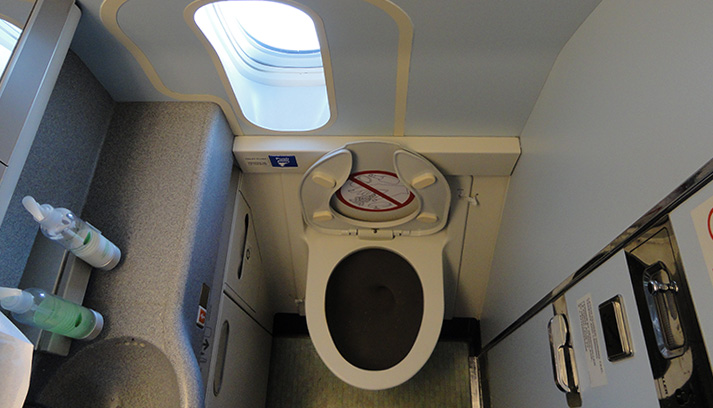
While some people find it acceptable to flush the toilet without getting up, this is not the case with airplane toilets. Airplane toilets are vacuum toilets, first installed by Boeing in 1982. They require very strong suction to remove waste with minimal water. This suction draws the waste into a holding tank, where it remains for the duration of the flight and is then removed after landing.
It's not recommended to flush the toilet while sitting on an airplane, as flushing creates a very high vacuum pressure, which can cause you to become trapped in the bowl. This is why most airlines have a sign that says, "Do not flush while sitting on the toilet." Avoid these awkward situations by standing up before flushing. (source)
2. Flying on an airplane when you have the flu or a cold can damage your eardrums, which can lead to hearing loss.

Flying is often a stressful experience for the ears, as passengers often experience ear discomfort or pain during the flight. This discomfort is typically caused by sudden changes in altitude, as the air pressure inside and outside the eardrum is usually the same.
The air pressure inside the eardrum doesn't have time to equalize with the pressure outside the ear, causing discomfort. However, the discomfort can usually be relieved by swallowing something, chewing gum, yawning, holding air in your mouth, pinching your nose, and forcing air through your ears until they pop.
But these remedies won't help if you have a cold. The discomfort will likely worsen, as your ears are already clogged due to the cold, making it impossible to equalize air pressure. This can lead to an ear infection or a ruptured eardrum, which in turn can cause more serious problems, such as hearing loss or permanent ear damage. (source)
3. Few people know that flight attendants have their own separate sleeping quarters on board airplanes. This usually applies to long-haul flights.

On long-haul flights, flight attendants need to take breaks, and aircraft designers have found ways to create additional space for them while still leaving as much room as possible for paying passengers. These rooms are usually very small, and the resulting space is quite cramped, but they have everything necessary. Most Boeing 777 and 787 aircraft typically feature a hidden staircase leading to the crew rest area.
Flight attendants do not use these compartments during takeoff, taxi, or landing, but only when the aircraft is at cruising altitude. Passengers are not allowed to access these areas, and a key or code is usually required to enter.
The design of the compartments varies depending on the aircraft design. Pilots also have their own rest area. Crew rest compartments are typically located in the upper portion of the aircraft. Cabins are typically not available on regular flights, but only on long-haul flights. Sleeping compartments are secret compartments containing sleeping bags and some entertainment systems. (source)
4. Airplanes are designed to fly for long periods of time with just one engine running.

A twin-engine aircraft is designed for long flights with one engine running. The aircraft is capable of takeoff and landing with just one engine, so engine failure is usually not a serious problem. In the event of engine failure, pilots are trained to control the aircraft and find the nearest airport for landing.
Aircraft engines are designed to withstand most impacts and remain operational. For example, if an engine fire occurs, airplanes are equipped with built-in fire extinguishers that pilots can activate from the cockpit. The fire is usually extinguished, but if it isn't completely extinguished, the engine casing is fireproof and contains the flames, preventing their spread. Even if one of the blades at the front of the engine breaks off, the engine casing will contain it and prevent damage to the wing or fuselage.
Most passengers are unaware of engine failures because pilots are well trained to deal with such situations and conceal them from passengers unless the situation worsens and puts the aircraft at risk. (source)
5. The cockpit has an emergency hatch that allows the pilot to leave the aircraft in case of an emergency.

Passengers have access to several emergency exits on an airplane, but few people know that pilots have their own emergency hatch with pulleys inside the cabin. The emergency hatch is located in different places on different types of aircraft.
Some aircraft have an emergency hatch located in a side window that opens inward and slides down. Above the window is a storage box with a rope that the pilot can use to descend and exit the aircraft. Some aircraft also have a roof-mounted emergency hatch as the only exit from the cockpit. Some aircraft have both exits in case the aircraft lands on its side and the side emergency hatch becomes blocked.
An escape hatch provides pilots with the ability to exit the aircraft in the event of an emergency where they need to leave the aircraft. (source)
6. The toilet door on an airplane can be opened from the outside even if it was closed from the inside.
Sometimes people get stuck in airplane lavatories, and flight attendants have to find a way to open the door themselves. This is possible because airplane lavatories have a mechanism on the outside that allows them to be unlocked.
If you lock the door after using the airplane restroom, you won't realize it's locked. The airplane restroom door can be opened from the outside. So, no one is actually locked in an airplane restroom. It can always be opened.
All you need to do is lift the panel on the toilet door where it says "toilet" or "vanity," which reveals the release mechanism. Then, slide the mechanism's latch to the left, and the door will open. Of course, this method should only be used if necessary, to assist someone, or for safety reasons. (source)
7. Food served on airplanes sometimes seems tasteless. This may be because the taste buds are dulled by the cabin pressure.

Airplane food is usually unimpressive, often seeming bland. But the food isn't the problem. Taste buds also contribute to the lack of flavor in in-flight meals. During a flight, the sense of taste is impaired, as taste buds tend to become numb. This makes all meals eaten during the flight seem bland.
According to the German Fraunhofer Institute for Aerospace Research, food was tested under high-pressure conditions and at sea level, and it was found that the taste of dishes differed in both environments. It was also discovered that the human ability to distinguish saltiness and sweetness was reduced by up to 30 percent due to high altitude. Furthermore, the humidity on board the plane decreased, which led to the drying out of the taste buds needed to perceive the flavor of food.
Airplane food isn't always bad, but the high cabin pressure makes it difficult for passengers to truly enjoy their meal. (source)
8. A tiny, unnoticeable hole in an airplane window regulates the air pressure between the windows and prevents them from fogging up.

Most people look out an airplane window and never notice an unusual feature. There's a tiny, almost invisible hole in the window called a "vent.".
As an airplane climbs to higher altitudes, cabin pressure drops. Airplane windows are designed to cope with this pressure. Airplane windows typically consist of three panes of acrylic glass. The middle pane has a hole in it, and the outer pane is designed to absorb most of the air pressure.
These vents regulate the pressure between the outer and inner panes of the window. In the rare event that the outer pane fails, the middle pane takes over the vent function and can independently manage the pressure. The vents also help prevent window fogging by releasing moisture through the opening. (source)
9. Oxygen masks in airplanes contain enough oxygen for 12-15 minutes, during which time the pilot must descend the plane to an altitude suitable for normal breathing.
Oxygen masks are essential on airplanes because they provide protection in the event of a loss of cabin pressure. Because airplanes fly at high altitudes, the air becomes very thin and oxygen levels are quite low, so the aircraft is designed to maintain cabin pressure at an acceptable level. However, if for any reason the cabin pressure drops, oxygen masks will drop from the ceiling, and passengers will be asked to don them until the pilot can raise the plane to an altitude safe for normal breathing.
Most people don't know that the oxygen supplied by the masks lasts only 12-15 minutes, during which time the pilot reaches a safe altitude where he can breathe normally.
Failure to use an oxygen mask after cabin pressure loss can result in hypoxia—a lack of oxygen to the brain—which can ultimately lead to brain damage or death. (source)
10. The aircraft black box is designed to withstand an impact load of 3400 G and temperatures exceeding 2000 °C.

«A black box is a flight recorder that stores information about conversations between crew members and air traffic controllers, flight control data, and technical information about the aircraft's performance.
The housing consists of a thin layer of aluminum and a one-inch layer of high-temperature insulation. The housing is then encased in a corrosion-resistant titanium or stainless steel casing. The signal from the housing is inaudible to the human ear but easily detected by sonar. The black box is designed to withstand any collision.
The box is designed to withstand 3,400 times the force of gravity and must also withstand fire temperatures of up to 2,000 ° C for an hour. The box's beacon is capable of transmitting a signal every second for thirty days, even while 20,000 feet underwater. (source)