






[Editor's Note: The following review contains spoilers to episode 8 of season 3 of the series "Euphoria" entitled "In God We Trust" - the final episode, including the ending.]
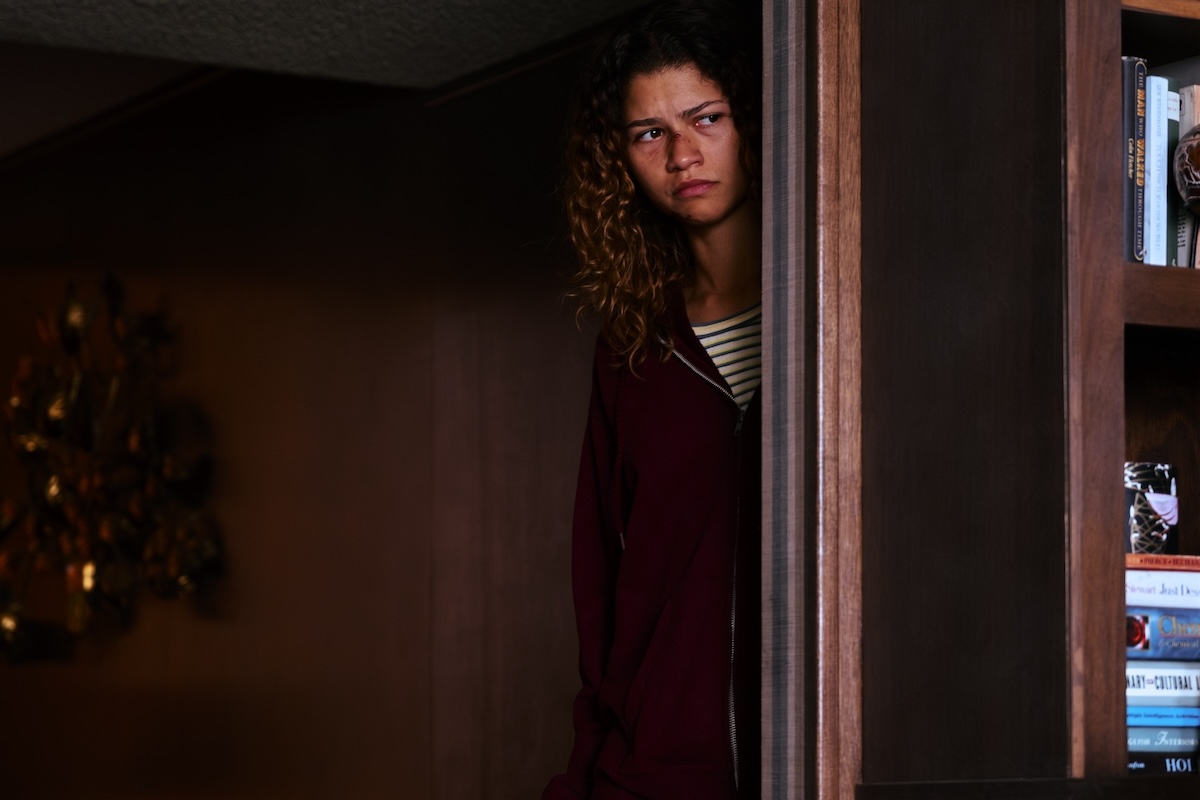
Midway through the final episode of Euphoria, when Rue (Zendaya) sees her mother, Leslie (Nika King), for the first time in years, a look of such joy crosses her face that it's heartbreaking. Cinematographer Marcel Rev's soft lighting highlights her tear-stained smile, underscoring her hope to return to a place she feared would forever remain inaccessible. The moment is a direct culmination of Rue's entire season three banishment from her teenage bedroom and that ominous hallway. Rue has occasionally expressed a desire to return, but even without explanation, her world beyond those walls is so terrifying that they feel like salvation.
But then Leslie raises her hand, and it becomes clear that salvation is no longer within reach. Leslie, sitting alone in the dark, reading the Bible, is already a bizarre enough scene even before Rue appears around the corner, but her silent reaction to her daughter's long-awaited but difficult arrival is simply too absurd to be believed. Unsurprisingly, a few seconds later, the scene switches to what's actually happening: Rue is back on Ali's (Colman Domingo) couch, taking a lethal dose of Percocet left for her by Alamo Brown (Adewale Akinnuoye-Agbaje), and experiencing a vision of a peaceful reunion she will never achieve.
Zendaya always performed brilliantly in scenes like this. Her smile in the fantasy expresses relief and clarity, which is especially striking after she's watched the horror build before Leslie notices her. Then her smile on the couch becomes silly and childish, as if she's only experienced a level of happiness completely detached from reality. When it dawns on her that Rue is about to die, euphoria, which she experiences is simultaneously pure and polluted - a contradiction forced upon her by the drug that caused Roo's death.
To say that Euphoria should have ended there would be both true and not quite true. Yes, the only consistent thread in creator, writer, and director Sam Levinson's controversial HBO drama is death: Rue is constantly on the edge, whether using hard drugs at school parties early in the series or smuggling drugs across the border in later episodes. As an addict, she's stuck in a vicious cycle, with no clear escape.
But… that's not enough. Pointing out the cycle of addiction while vaguely hinting at the systems that sustain widespread fentanyl use doesn't mean the surrounding plot makes sense. It's no excuse to spend so much time—especially in a bloated, boring third season, which ended with a bloated, boring finale (which somehow only had time for one silent scene with Jules?)—on the suffering of young people. It's not enough to sustain a season (and perhaps an entire series) that contributes nothing to the problem other than rage and pessimism.
And Levinson seems to realize that's not enough after those ridiculous last 40 minutes.
Colman Domingo in "Euphoria." Photo courtesy of Eddie Chen/HBO.
In Euphoria, the point of view switches from Rue to Ali (aka Martin) as she dies, and he manages to deliver two revealing speeches about what it all might mean. (If you're going down that path, you might want to hire Domingo to deliver it.) In the first, delivered at his final Narcotics Anonymous meeting, he admits, "I used to believe the world would be a better place if people could empathize with addiction... Maybe empathy isn't so helpful... Maybe the real disease is that people no longer distinguish between right and wrong. I don't care what hardships you face. If you poison children for money, you are evil. Plain and simple.".
It sounds a lot like the "angry" phase of grief, doesn't it? So, old Martin decides the best way to help is to don his old army uniform, saw off his shotgun, and head to the Silver Slipper. There, Levinson's clunky Western motif comes to its inevitable conclusion with a showdown between Black Hat and No Hat, evil and once-good, Ali and Alamo. The winner is essentially certain, and Levinson doesn't wring much tension out of the drawn-out scene (despite Ali being surrounded by a multitude of armed guards for most of the time). So when Alamo meets his maker, the real question is, what does it mean to Ali that he introduced them?
It turns out it's nothing special. He's visiting the Miller family—the farmers with whom Rue stayed in the Season 3 premiere—and says he's come on behalf of his daughter. Mr. Miller invites him inside for a little chat, then asks Martin to say a prayer before they share a meal. "Today I pray for those whose eyes are dim with sorrow, whose souls and bodies are heavy with grief, and whose strength is failing," Martin says. "Lord, pour out Your mercy upon them. Let Your face shine upon them, and save them in Your unfailing love. Thank you, Rue. May her memory be a blessing.".
And then the symbolically empty chair at the end of the table is filled with the actual ghost of Rue. "Amen," she says, and that famous smile spreads across her face.
So, what does this ending tell us? If Martin had gone to the Millers' immediately after his relapse (he admits to drinking after Roo's death), the final scene would have made more sense. Everyone stumbles. Everyone needs help sometimes. Everyone will ask for help or need it, and all we can do is give what we can. He would have gone on a pilgrimage to rekindle the empathy he lost after writing Roo's name in his book of the dead.
However… there is no sign that Martin regrets his bloody vengeance. On this ugly little farm in the desert, does he once again humble himself before a higher power, or will he continue to persecute all who poison children for money and are therefore evil? Is he trying to find peace in the place Rue described as the most peaceful place on Earth, or is he trying to come to terms with the exception he carved out for himself in the Ten Commandments? «Thou shalt not kill, If "Don't you think they're really evil?"»
Sydney Sweeney and Alexa Demie in "Euphoria." Photo courtesy of Eddie Chen/HBO.
I'm not here to defend Alamo Brown, nor am I here to argue that Always You have to turn the other cheek. The bad guy had to go, and I'm glad he's gone. But in its spectacularly flawed finale, Euphoria tries to tread water. On the one hand, there's an empty but "honest" depiction of Rue's most likely fate. On the other, there's an overly dramatic but contrived revenge for her death. Are we really supposed to care equally about both outcomes? Are we even supposed to believe that both outcomes are part of the same show? These scenes are diametrically opposed in style and content, and could only coexist if the ridiculous final moment had also ended with a twist, or at least the possibility of one—while Martin's massive shootout was also a fantasy.
That confession never happens, leaving us to believe that's exactly what happened to Alamo, Bishop (Darrell Britt-Gibson), and Maddie (Alexa Demie). (I love that couple, by the way.) We end up with Cassie (Sydney Sweeney) alone in her modern-day brothel, and Lexi (Maude Apatow) back on the moral high ground without quite understanding why. (Note: The disdain shown toward these two women is laughable, and their final conversation about the Bible is the final straw. "I think that's the whole point," Lexi says. "Bad things happened. So why worry about them? What good does it do? Whatever happens, you just keep going. I think that's the point." … What? From what I can only assume was a cursory glance at Scripture, she concluded that God endorses nihilism? And Cassie can't even comprehend that! "What does that have to do with the Bible?".
These final remarks about the characters, whether they read as youthful naiveté or an insulting interpretation of youthful naiveté, heighten the finale's bitter aftertaste. While the ending hopes you'll mistake the residual nastiness for grief over the protagonist's death, more likely, that feeling is rooted in disappointment. After three seasons and a four-year wait for the final episodes, Euphoria can't even muster the courage to be honest about its ending. Instead, it confesses to one fantasy while trying to convince you of another.
Wow!
Rating: D
The third season of Euphoria is available on HBO and HBO Max.
Subscribe to the Indiewire newsletter. For the latest news, follow us on Facebook, Twitter, and Instagram.